A slow kitchen sink drain may start at the removable basket, the disposal outlet, or a pipe shared by both bowls. First check where water collects and whether it is draining away or coming back up. Stop using the sink and dishwasher if the level rises, water leaks into the cabinet, or another fixture backs up. A running garbage disposal does not prove the drain beyond it is clear.
This guide covers an ordinary household kitchen sink. For several affected fixtures, use the multiple slow drains guide. For water escaping below the sink, begin with finding the first wet location. Commercial grease interceptors and pumped drainage systems need their own service instructions.
Match the drainage pattern before choosing a fix
Use observations from normal use rather than filling both bowls to create a test. The same visible pool can have different causes. The table identifies the next question, not a guaranteed blockage location.
| What happened? | What it suggests | Next step |
|---|---|---|
| Water pools around a basket covered with scraps. | The removable strainer may restrict the opening. | With water off, clean only the removable basket as described below. |
| One bowl is slow; the other seemed normal. | A local restriction is possible, but the shared pipe is not ruled out. | Note which side has a disposal and whether water moved between bowls. |
| Both bowls are slow, or water enters the other bowl. | The bowls may be affected by their common drainage route. | Stop adding water; arrange assessment if simple surface cleaning does not resolve it. |
| The disposal hums or stops, with water remaining. | A disposal operating problem may accompany a drainage problem. | Turn it off; use its exact model’s service guidance. |
| Water rises in the sink when the dishwasher empties. | The appliance and sink drainage connection needs attention. | Stop using both; record whether this began after installation work. |
| A toilet, tub, or another room’s drain also reacts. | The problem may extend beyond the kitchen branch. | Follow the shared-drain warning signs. |
A limited first check: clean the removable basket
For a plain sink opening without a disposal, start with the part designed to lift out for everyday cleaning. The loose basket or stopper is different from the fixed metal flange sealed into the sink.
- Turn off the faucet and stop the dishwasher. Let ordinary sink water recede if it is draining. Do not handle sewage or water containing chemicals.
- Lift out the removable basket only if it comes out normally. Do not unscrew the flange or force an unfamiliar stopper.
- Empty collected scraps into the appropriate trash or food-waste container. Clean the basket away from the blocked opening so debris does not go straight back down.
- Once the bowl has emptied, and there is no leak or backup warning, make one brief, attended check using normal faucet flow. Stop as soon as water starts accumulating. Do not fill the bowl to prove that it drains.
If flow improves only while the basket is removed, inspect its slots, seating, and intended open position. If the bare opening still drains slowly, the basket was not the whole problem. Photograph the result and move to the drainage-pattern check rather than repeatedly rinsing scraps into the pipe.
Why does one side of a double sink back up into the other?
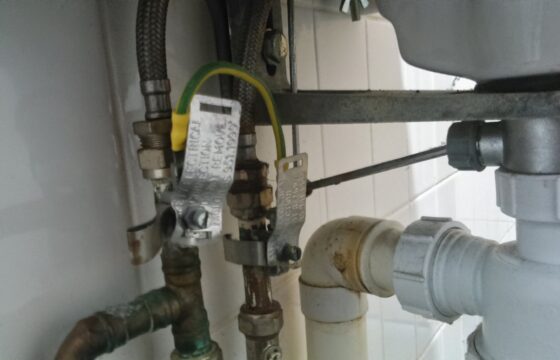
Two bowls commonly join before the drain continues into the wall. When water cannot leave that common route freely, it may become visible in the other bowl. The exact connection arrangement varies, so a photograph of the visible pipes is more useful than assuming every double sink has the same layout.
Both kitchen bowls being affected does not by itself establish a main-sewer blockage. Compare that observation with symptoms already noticed in the bathroom, laundry, or lowest fixtures. Do not deliberately run those fixtures to reproduce a backup. Water rising in a tub or shower changes the response: follow the backup first steps.
Slow kitchen sink drain with a garbage disposal
Separate two questions: did the disposal operate normally, and could the water leave? A jammed mechanism and a restriction farther along the drain need different responses. Record the sound and behavior you already noticed; do not repeatedly switch on a humming unit to push water through.
InSinkErator’s jam guidance separates instructions by disposal type and explicitly warns against putting a hand into the unit. Turn it off. Before any service, follow the correct instructions for disconnecting power; do not touch a wet connection or attempt hardwired electrical work.
If the disposal was operating but the sink stayed slow, the downstream pipe still needs consideration. InSinkErator’s clogged-disposal guide distinguishes a possible drain-line blockage from a jammed or non-starting disposal. If the sink remains slow after limited safe checks, arrange plumbing assessment. Resetting the motor is not evidence that the pipe has cleared.
Is a sink plunger appropriate?
Some manufacturers describe plunging for a compatible sink and disposal arrangement. It is not the next step when chemicals are present, joints are leaking or loose, sewage is returning, or the installation is unknown. In a double sink, an unsealed second opening can let the plunging action escape there; the linked InSinkErator guide addresses that arrangement.
Use the sink and appliance instructions to decide whether a limited attempt is suitable. Keep the disposal off and prevent accidental operation. Stop if water appears below the sink, splashes from another connection, or does not improve. Do not escalate to a powered cable through the disposal or loosen drain fittings under a full bowl.
What if water rises when the dishwasher drains?
Stop the cycle using the appliance’s normal controls and follow its manual; do not start another cycle or repeatedly select drain to test a sink that is backing up. Note whether water appeared in a sink bowl, at a countertop air gap, or on the cabinet floor. Those locations describe different symptoms. For water spilling from the identified fitting, use the dishwasher air-gap overflow guide.
After a recent disposal replacement, tell the installer whether the dishwasher drainage changed immediately. InSinkErator’s installation instructions include a dishwasher inlet plug and the drain-hose connection. These are items for the installer to verify, not a reason to strike or dismantle an installed, powered unit.
If the dishwasher holds water but the kitchen sink drains normally, use the dishwasher not draining checks to compare cycle completion and model-specific retained water. If both are affected, tell the technician that too. Do not replace an appliance pump solely because water appeared in the sink.
Grease, food waste, and recurring slow drainage
Food residue and grease belong in the history you give the plumber, but neither can be confirmed as the cause from a photo of standing water. A drain that briefly improves and becomes slow again deserves assessment beyond repeated surface cleaning.
For prevention, keep cooking oil and grease out of the drain. Collect cooled cooking grease for disposal according to local waste guidance, scrape dishes, and empty removable strainers regularly. A disposal does not make grease suitable for the plumbing. Avoid treating a kettle of boiling water or a mixture of household products as a universal repair for unidentified pipes and a partly blocked sink.
For homes on septic, the EPA’s septic-care guidance advises keeping grease out and limiting disposal use to reduce the solids entering the system. A slow kitchen sink alone does not establish that the tank needs pumping.
Video reference: EPA’s “Think at the Sink!”
For a septic household, this EPA prevention video explains what to keep out of the drain. It is not a demonstration of diagnosing or clearing your sink.
When to call and what to record
Arrange plumbing help when ordinary use causes rising water, the problem returns after limited cleaning, both bowls remain restricted, or moisture appears underneath. For sewage backup or symptoms in several rooms, stop household water use and seek prompt help. Renters should report the pattern to the property manager before altering plumbing.
Send observations instead of a guessed part order. This short record is also useful if the sink happens to drain normally when the plumber arrives.
| Record | Useful detail |
|---|---|
| First affected location | Left bowl, right bowl, disposal side, air gap, or cabinet floor. |
| Timing | During faucet use, after food preparation, or when the dishwasher emptied. |
| Direction of water | Slowly falling, remaining still, or rising from the opening. |
| Other symptoms | Other affected fixtures, sounds, leaks, and when they occurred. |
| Work and products already used | Recent installation, basket cleaning, drain-cleaner name, and time used. |
| Photos and model details | Full sink and accessible drain layout; disposal and dishwasher model labels if safe to read. |
Ask whether the proposed service covers the kitchen branch, the appliance connection, or a wider drainage problem, and how restored flow and leak-free connections will be checked. Keep the findings in your plumbing maintenance record.
Frequently asked questions
Is a kitchen sink that eventually drains still blocked?
It can still be partly restricted. The water eventually disappearing does not show that the drain can handle normal use. Record whether the delay is new, recurring, or worsening.
Should I replace the garbage disposal first?
No. Establish whether the issue is operation of the appliance or water leaving through the drain. A new disposal will not necessarily correct a restriction in the connected pipe.
Can I use the other bowl while one side is backed up?
Do not assume it is independent. The bowls may share drainage, and added water can reappear in the blocked side. Pause use until the pattern is understood.
What if there is also a gurgling sound or odor?
Record when it happens. The sink-gurgling guide and sink-odor checks cover those observations. A sound or smell alone does not identify a failed vent or prove where a clog lies.
Research-based guidance for US households, checked September 21, 2026. Photo and video are credited reference material, not a repair performed by The Home Fix Guide. Model instructions and local requirements take priority. See our Editorial Policy.