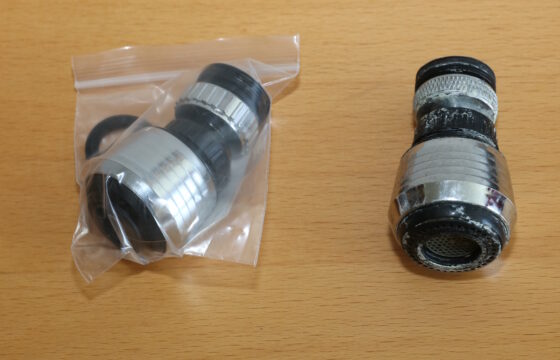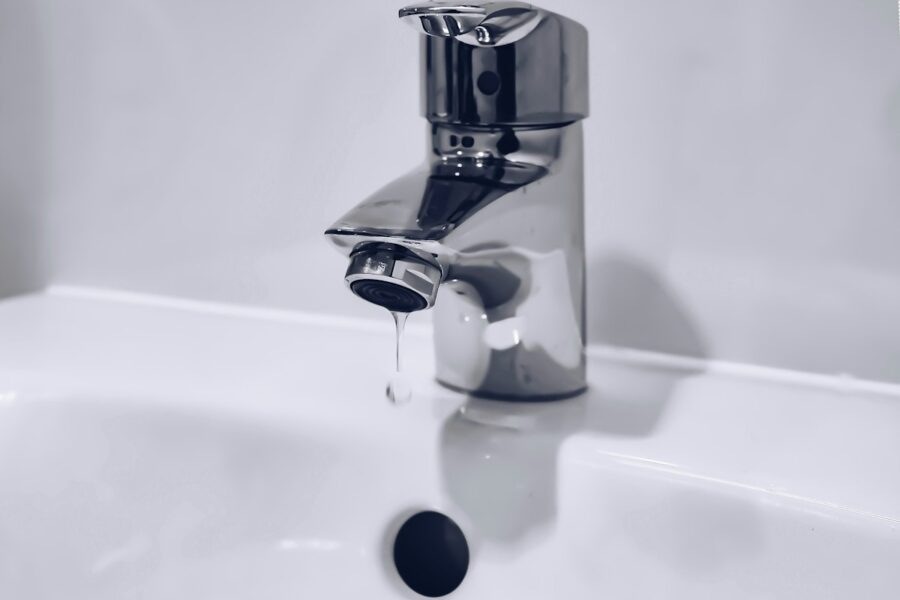
Low water pressure at one faucet is often a local flow problem rather than low pressure throughout the home. Compare hot and cold water and check whether other fixtures work normally. A blocked aerator or spray head can restrict flow locally, while a one-sided problem may involve the supply or cartridge. Identify the faucet model before removing parts or making adjustments.
This guide covers ordinary kitchen and bathroom sink faucets. It does not cover boiling-water dispensers, filtration systems, shower mixing valves, or electronic controls. A weak stream is a symptom; it is not a measurement of household water pressure.
Several fixtures affected instead? Use the weak-flow troubleshooting overview to choose between outlet checks and a pressure test.
Low water pressure at one faucet: separate low flow from low pressure
If the faucet delivers water normally but it collects in the basin, that is a drainage symptom. Use our slow bathroom sink drain guide for stopper checks and signs that need professional attention.
Flow is the volume delivered over time, often expressed in gallons per minute (GPM). Pressure is force per unit area, commonly recorded in pounds per square inch (psi). To measure it, use a suitable water-pressure gauge and record the test conditions. A restricted outlet can reduce the stream even when the supply pressure is adequate.
For that reason, do not adjust a pressure regulator or water-heater setting just because one sink feels weak. First determine whether the change affects one fixture, one temperature, or the whole home. That distinction helps keep a small outlet problem from becoming an unnecessary plumbing project.
If the shower is the only weak fixture, follow our shower-only low-flow guide for the relevant comparisons.
Make three comparisons
| What you observe | Where to go next |
|---|---|
| Only one faucet is weak on both hot and cold | Start with the model-specific outlet check. An aerator, spray head, or another restriction may be involved; this pattern does not prove which part failed. |
| Only hot or only cold is weak at one faucet | Use the one-sided-flow checks before assuming the outlet is blocked. Record which side is affected. |
| Several fixtures are weak even when used one at a time | Follow the whole-house low-pressure checks and record which fixtures changed. |
| The faucet is normal alone but weak when another fixture runs | Use the simultaneous-use flow and pressure guide; note which fixtures were running. |
| One pull-down spray mode is weak but another mode is normal | Record the affected mode and use the instructions for that spray head. A wand is not the same assembly as a removable aerator. |
| A new faucet flows less than the previous fixture | Compare its rated flow and test conditions before assuming a defect. For a WaterSense bathroom faucet, see the certification test points. |
Moen’s low-flow guidance uses the same hot/cold distinction and specifically notes that one-sided low flow can come from a shutoff, supply line, or obstruction before cartridge-level service. Moen one-sided low-flow reference. Its both-sided low-flow guidance also separates aerators, spray wands, and other model-specific causes.
At the affected sink, observe cold flow and then hot flow, using normal handle positions. Avoid putting your hands in potentially scalding water. Compare another nearby sink and, if practical, a fixture elsewhere in the home. Keep other water use steady while comparing.
Write down when the problem started. Did it follow plumbing work, a service interruption, replacement of the faucet, or a gradual decline? This history is useful evidence, but timing alone does not prove a particular part failed. Use the faucet flow observation record to keep the conditions and results together.
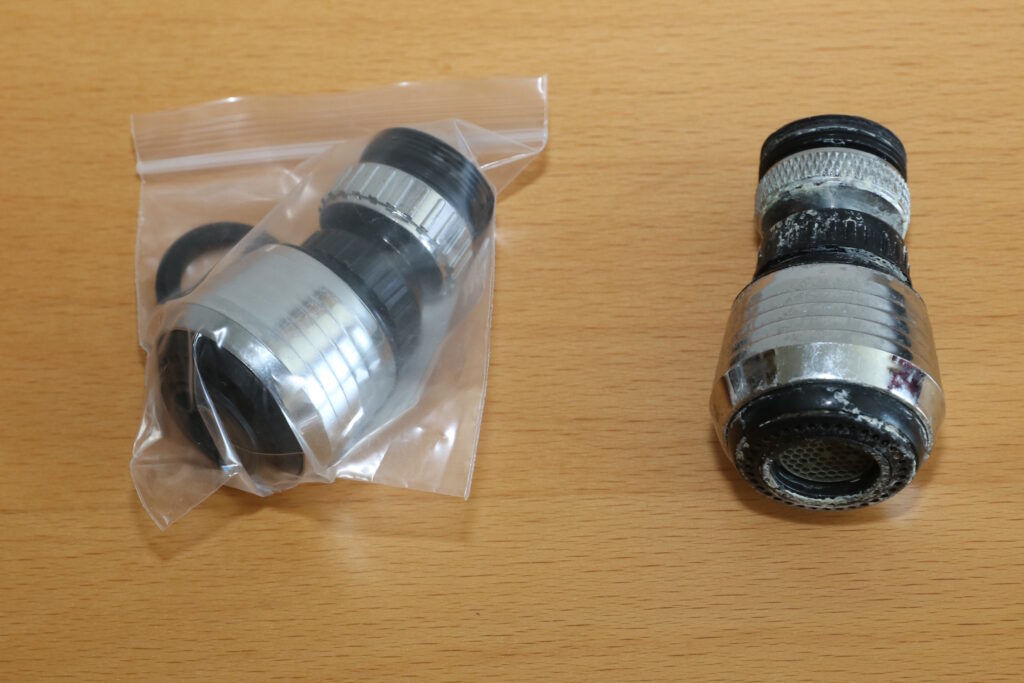
Inspect the outlet without damaging the finish
| Observation | What to investigate next |
|---|---|
| Flow improves after the correct outlet cleaning | Reinstall all specified components and check for leaks. Record the improvement. |
| Both hot and cold remain weak at this faucet only | Check accessible hoses and the faucet’s model-specific service guidance. |
| Only hot or only cold stays weak | Report which side is affected; the restriction may be before the mixing point. |
| Several fixtures are weak | Move to the whole-home supply checks instead of repeatedly cleaning this outlet. |
Watch an aerator replacement before handling the outlet
The EPA WaterSense demonstration in our aerator guide shows a removable aerator. Watch it there alongside the cleaning steps; it does not establish that your outlet is faulty or apply to every concealed insert or pull-down head. Open the original EPA video for the third-party demonstration.
Identify the faucet and outlet before choosing a maintenance procedure. Moen’s kitchen low-flow guide separates aerators, side sprays, and pull-down wands because their service paths differ. Do not force a seized fitting or treat the entire spray head as a removable screen.
Clean only as the manufacturer directs
Use the accessible-surface cleaning check or, when the model permits removal, the serviceable-aerator procedure. Follow the component and finish instructions; do not mix cleaners, force a fitting, or alter flow-control parts.
After correct reassembly, compare the same cool-water setting and check for leaks. Use the result table above to choose the next investigation if flow stays weak; outlet cleaning cannot resolve every supply, hose, or cartridge problem.
What if only hot or cold is weak?
Moen’s one-sided-flow guidance includes checking supply valves and lines. For a homeowner, begin with observation: was a valve recently closed, is a visible hose sharply bent, or is there moisture under the sink? Do not disconnect a live supply line to test it.
If a shutoff is old, leaking, stiff, or unfamiliar, have a plumber handle it. A simple-looking adjustment can turn into a supply leak. A cartridge may also require attention, but the correct service procedure depends on the model and the supply conditions.
When more than one fixture has weak hot flow, do not assume all the aerators failed at once. Use the hot-water-only low-flow guide to record which fixtures are affected. Contact an appropriate professional for a broader diagnosis. This guide does not instruct you to open a water heater or alter gas or electrical equipment.
Check whether the faucet is operating as designed
A new water-efficient faucet can feel different from an older one without being defective. Check the rated flow on its specification sheet. The EPA’s bathroom-faucet guidance describes water-efficient lavatory products; do not apply a bathroom specification indiscriminately to a kitchen faucet.
For a simple flow observation, use a container with known volume, a timer, and cool water. Keep the container stable and avoid overflow. Record how much water you collected and for how long. Do not compare a casual home measurement directly with a laboratory rating without considering the manufacturer’s test conditions.
For example, collecting 0.5 gallon in 30 seconds gives 1 GPM: volume divided by seconds, multiplied by 60. This is a calculation example, not the required output of your faucet. A result helps describe the problem; it is not a pressure test.
Keep a faucet flow observation record
Copy this blank template into your notes. For a before-and-after comparison, use the same cool-water handle setting, spray mode, and other water-use conditions. Skip collection if water cannot be contained safely.
Date / time:
Faucet location and make / model:
Installed model / accessory rated flow (GPM):
Specification's flow-test pressure (psi), if stated:
Hot, cold, or both affected:
Spray mode and nearby-fixture comparison:
Other water use during the observation:
Before / after which cleaning or repair:
Cool-water handle setting:
Collected volume (US gallons):
Elapsed time (seconds):
Calculated flow (GPM = gallons / seconds x 60):
Any leakage after reassembly:
Question for the manufacturer or plumber:
Keep the measured volume and time with the calculated GPM. This describes that observation; it is not a psi reading, a universal pass/fail threshold, or proof that a particular part needs replacement. A hot/cold comparison can remain a visual observation without collecting hot water.
When to stop and call for help
Call a plumber for a leaking shutoff, corroded connection, unexplained one-sided restriction that persists, or a part that cannot be removed normally. Contact the utility about a sudden change affecting the whole home, especially if neighbors report the same issue or service notices are posted.
If you notice unexpected water use as well as weak flow, our water meter leak test explains a separate screening check. A low-flow symptom alone does not establish that a leak exists.
Repair cost questions worth asking
Ask whether the proposed work is cleaning an outlet, replacing an aerator or wand, servicing a cartridge, or investigating the supply. These are different scopes. For a professional quote in USD, clarify diagnostic fees, parts, labor, and whether further work needs your approval.
Before ordering, identify the exact part and check warranty eligibility with the manufacturer. Do not assume parts or labor will be free. This article does not provide a national price estimate for an undiagnosed problem.
Frequently asked questions
What if the faucet also drips when turned off?
That is a different symptom. Read our guide to a faucet that keeps dripping after shutoff before assuming outlet cleaning will fix it.
What should I send the manufacturer?
Include the model, photographs, whether hot and cold are both affected, the affected spray mode, and when the change began. Keep personal account details out of public support posts.
Explore more checks in Plumbing & Water. Research checked September 12, 2026; see our Editorial Policy.
Illustrative photo: Sasikan Ulevik / Unsplash. It does not depict a diagnosed fault or a repair performed by our publication.