If your shower head keeps dripping when the water is off, first check whether the dripping stops completely or continues during a long period without use. Brief drain-down can be water left in the head, hose, or pipe; continuing dripping can involve the control valve. Record the timing and first wet point before replacing parts. A new shower head may not fix a valve that is letting water through.
The safest first check is observation after ordinary use. You do not need to remove the valve trim, open the wall, or repeatedly run the shower to decide whether the symptom needs professional investigation.
Water at a wall, supply joint, or another fixture calls for a different check. Compare the visible-leak troubleshooting paths.
Find the exact place the water comes from
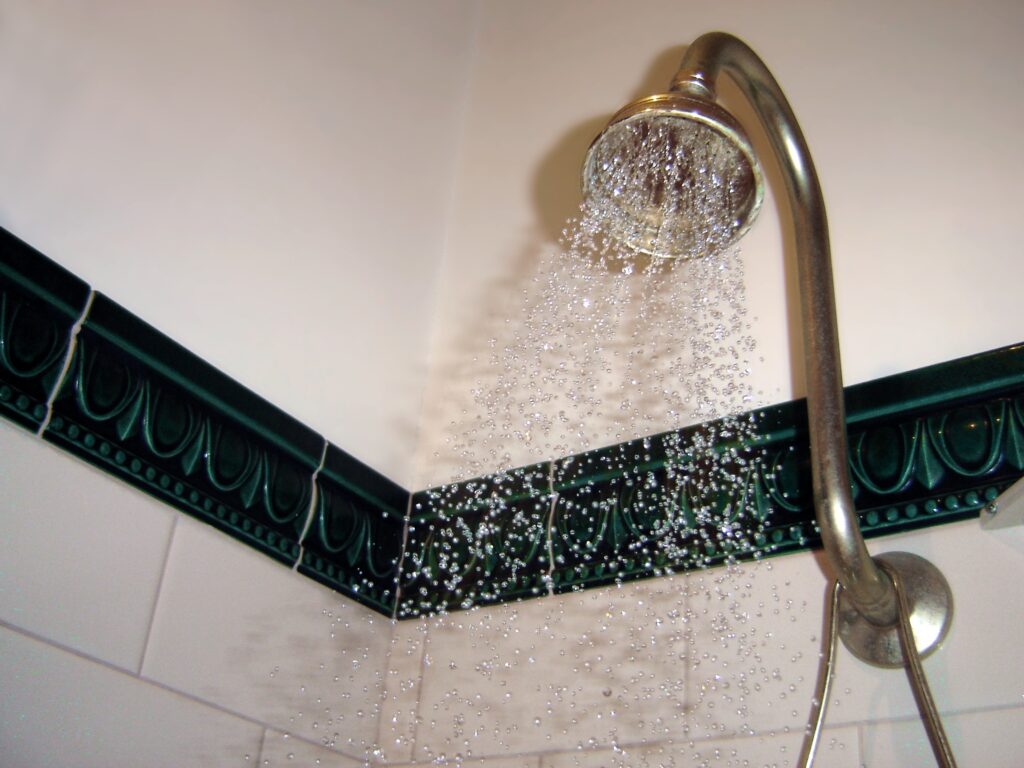
Take a short video from outside the wet area, with the shutoff time noted. A continuing nozzle drip can involve the control valve behind the wall; replacing the visible shower head alone may miss it.
Water can leave the spray nozzles, a hose connection, the handle, or the point where the shower arm meets the wall. Look from a dry, stable position with the control in its normal off position. Do not force the handle farther than its usual stop.
| Location or timing | Possible explanation | Useful next action |
|---|---|---|
| A diminishing drip from the nozzles after use | Residual water draining | Record when it stops and whether it remains stopped. |
| Steady nozzle dripping during a long period without use | Water passing the control valve | Identify the valve model and arrange service. |
| Water at a hose coupling while running | A connection or washer problem | Follow that hose’s instructions; avoid overtightening. |
| Water around the handle or wall opening | A seal, valve, or concealed connection problem | Stop using the shower and seek help. |
| Shower flow while only the tub spout is selected | Diverter or installation-related behavior | Compare tub-filling flow with after-shutoff dripping. |
Water stains below the bathroom, a soft wall, or moisture outside the shower are reasons to stop routine checks. Visible droplets at the head do not tell you whether a hidden leak is also present.
How long should a shower head drip after you turn it off?
Write down the time you turned the shower off. Note the pattern at the end of use and during a later check: a brief trickle, isolated drops, complete stopping, or a steady continuing drip. There is no single time limit that applies to every shower assembly.
Kohler’s Rite-Temp troubleshooting distinguishes residual showerhead water from valve leakage and describes residual dripping for up to 90 seconds in its discussion. Treat that as product-specific guidance, not proof that every drip lasting longer than 90 seconds requires a new cartridge.
A large head, a handheld hose, and multiple outlets can have different drain-down behavior. Observe the system as normally installed. Do not cap an outlet or add a shutoff attachment to conceal a leak. A pause button on a handheld shower is not a substitute for turning the main shower control off.
If the drip repeatedly resumes after the shower has been unused, report that timing. Do not label it harmless solely because the rate is slow. For a similar symptom at a sink, see our faucet dripping after shutoff guide.
Why is the shower still dripping after replacing the head?
The head shapes the spray. The control valve normally stops the supply. If water continues passing that valve, a new head may change the visible drip pattern without addressing the source.
Which valve repair matches a shower that keeps dripping?
For a confirmed valve family, the manufacturer can narrow the repair beyond “replace the shower head.” These two Moen examples apply to continuous dripping with the main control off, not ordinary drain-down:
| Confirmed valve family | Identification clues from Moen | Manufacturer-directed repair |
|---|---|---|
| Moen PosiTemp | Rotate-only handle; trim screws near 2 and 7 o’clock | Moen specifies a 1222 cartridge for persistent off-position leakage. |
| Moen Standard single-handle valve | Push/pull operation; trim screws near 5 and 7 o’clock | Moen lists the 1225/1200 cartridge for this valve’s continuous leak. |
Handle motion and screw positions are clues, not proof: other families can share features, and trim may have changed. These examples do not identify an unknown Moen, Delta, Kohler, thermostatic, or multi-handle valve.
Once the valve is confirmed, use its complete repair procedure. Moen’s PosiTemp instructions and Standard-valve instructions require supply shutoff before disassembly. Both warn against restoring water if the retaining clip cannot be correctly installed. An unidentified valve, failed shutoff, stuck cartridge, or damaged retaining hardware is a reason to use a qualified plumber.
Photograph the handle, trim, brand marking, and any records from the original installation. If you recently changed parts, keep their packaging. Do not order a cartridge based only on the shape of the handle; trim can be replaced without changing the valve behind it.
Check what changed before the dripping began
A short history helps separate maintenance from installation questions. Did the symptom begin after a head replacement, a valve repair, a bathroom remodel, or work on the home’s water supply? Did it always happen, or did it become steadily more noticeable?
Kohler describes delayed flow and back-pressure problems tied to specific valve installation requirements. This is a reason to give the installer the exact model and history rather than apply a universal piping fix. Do not open a finished wall based on a symptom description from another model.
If several fixtures began behaving differently at the same time, a home water pressure check may provide useful information for a plumber. A gauge reading does not, by itself, prove that pressure caused the shower leak.
Safe maintenance versus valve repair
You can inspect accessible spray nozzles and follow the head manufacturer’s cleaning instructions. Check the approved cleaner, dilution, contact time, and finish restrictions. Do not assume that an overnight vinegar soak is safe for every coating or plastic component.
If weak spray is also present, treat that as a separate observation and use the shower-only low-flow guide. Cleaning an obstructed spray opening can improve the spray pattern, but it does not necessarily repair a valve that fails to close.
Cartridge and valve work requires verified water isolation, compatible parts, and correct reassembly. If you cannot identify the valve and its shutoff procedure, hire a licensed plumber. Do not begin by removing retaining clips or the cartridge with the supply still on. Do not alter a temperature-limit stop to compensate for a leak or flow problem.
Before any repair is planned, establish where the household water shutoff is located. A stuck, unidentified, or inaccessible valve is a problem to resolve before disassembly.
Record the drip without overstating water waste
A photograph of the outlet and a short written log are often sufficient. Record whether the shower was used recently, whether the tub spout was involved, and whether the drip stopped completely. A brief video can show the pattern without requiring someone to recreate it on a service call.
A shower drip observation record to share with a plumber
Use observations from ordinary use and later checks. Copy the fields into your own notes; mark details you cannot confirm as unknown.
Open the copyable shower drip record
Date and time of observation:
Time the shower was last used and turned off:
Main shower control in its normal OFF position: yes / no / unknown
First wet point: spray nozzles / head joint / hose / handle / wall / tub spout / unknown
Drip pattern: tapers and stops / continues / stops then returns / unknown
Later check times and whether the shower stayed unused:
Damp wall, ceiling marks, or other visible damage:
Recent head or valve work and date:
Control valve brand, family, and model: confirmed details / unknown
Photos, short video, or installation records available:
Optional collected volume and elapsed minutes, only if safe:
Question for service: What evidence identifies the cause, and which model-specific part or work is proposed?
Keep any volume measurement with its exact observation interval. Share the record with the control valve identification details. For moisture at the wall or ceiling, use the prompt-help guidance.
If it is safe to place a stable measuring container below a continuing drip, record the collected volume and elapsed minutes. Keep the drain clear and do not leave a container to overflow. This observation is optional; skip it if reaching the outlet or floor is unsafe.
A measurement describes that interval only. For example, 4 fluid ounces collected in 10 minutes would equal 4.5 gallons in 24 hours if that rate continued unchanged all day. It would be misleading to apply that daily total to a shower that merely drains for a short time after each use. Do not convert a few observed drops into an annual bill claim without establishing duration and your actual usage rate.
When to get help and what a quote should include
Arrange service for a continuing or recurring drip, water around the handle, or a problem that began after valve work. Stop using the shower and get prompt assistance for concealed leakage, ceiling damage, significant uncontrolled flow, or unsafe temperature changes.
Ask for an estimate in USD separating diagnosis, the correct service kit, labor, and any wall access or finish repair. Confirm whether the plumber expects to service the existing valve or replace it and what evidence supports that choice. Ask whether manufacturer warranty parts are available for your product and circumstances.
A head-cleaning task and replacement of a concealed valve have very different costs. Agree on approval for additional access work before the wall is opened. After repair, ask the technician to check shutoff, connections, and temperature operation, not simply whether the new part fits.
Frequently asked questions
Is a little dripping after every shower normal?
It can be residual water, especially if the drip tapers off and stops completely. The relevant questions are whether the pattern changes and whether water continues arriving during long periods without use.
Should I tighten the handle harder?
No. Use its intended off position. Extra force can damage controls and does not diagnose an internal seal problem.
Can a clogged shower head cause this?
Deposits can affect spray and drain-down. Follow approved cleaning directions, but do not assume deposits explain continuous water passing a closed control.
Why does the shower drip while I fill the bathtub?
Featured photo: Zac Gudakov on Unsplash. Stock bathroom image used for context.