If only the shower feels weak, start by comparing nearby fixtures and checking the showerhead’s spray setting. Restricted flow at the head, a hose problem, or a shower-valve issue can feel like low pressure. A sudden change deserves investigation; a low-flow product’s rated output alone does not prove a fault.
This guide helps you describe and narrow the symptom before ordering parts. It does not cover opening concealed valves, altering pressure regulators, or servicing electronic shower systems. Leave those jobs to a qualified plumber and follow the instructions for your specific fixture.
Other fixtures affected too? Compare the weak-flow troubleshooting paths for showers, faucets, and household pressure.
Pressure and flow are different observations
If you need an actual pressure reading, follow our home water pressure test guide and record the test location. For a different symptom after use, compare shower head drain-down with a continuing leak.
Pressure describes the force in the water system; flow is the volume delivered over time. A spray that feels weak does not tell you the measured supply pressure. Avoid increasing a whole-house regulator simply because one shower is disappointing.
Start with a short record: did the problem appear suddenly, gradually, after cleaning, or immediately after a new showerhead was installed? Does it occur throughout the shower or only while another fixture runs? These comparisons are more useful than the description “bad pressure.”
Weak shower but normal tub or sink flow? Compare the outlets
Briefly check a nearby faucet using a comfortable water temperature, then another fixture if available. Observe each separately first. If everything is weaker than usual, the issue may extend beyond the shower; contact the building manager or utility about supply changes before purchasing a head.
If the sink alone is weak, see our single-faucet flow guide. A sink aerator and a shower cartridge are different components, so the remedies are not interchangeable.
If you have already noticed weak hot flow at several fixtures while their cold flow stays normal, use the hot-water-only low-flow guide. That is a different pattern from a shower-only problem. Do not reproduce an unsafe temperature change to compare outlets.
If the shower flow looks normal but the water stays cold while nearby sinks get hot, use the shower-only hot-water troubleshooting guide for that temperature pattern.
| Pattern already observed | Useful next check | What it does not establish |
|---|---|---|
| One spray setting feels weak; another behaves normally. | Record the selected mode and check Pause and outlet selection, then compare the rated output in the head’s manual. | A different spray pattern does not measure household pressure. |
| Handheld flow changes with hose position. | With water off, inspect accessible bends or visible damage without pulling or twisting the hose. | It does not prove that the concealed shower valve needs replacement. |
| The shower is weak but its tub spout seems normal. | Record both outlets and the same comfortable temperature setting. Start with the head, settings, and the matching valve’s troubleshooting instructions. | A tub spout and showerhead are not expected to deliver identical flow. This comparison does not select a cartridge or prove a blockage. |
| The tub and shower both changed, but a nearby faucet seems normal. | Record the shower-system model and whether the change occurs across safe temperature settings; ask for model-specific assessment. | A nearby faucet cannot verify pressure inside the shower valve. |
| Several fixtures became weak, or temperature becomes unstable. | For a wider supply change, contact the utility or property manager. For unexpectedly hot or unstable shower water, stop testing and seek service. | Do not use these clues to adjust a regulator, temperature stop, or anti-scald device. |
Model-specific reference: Moen’s PosiTemp low-flow guide separates shower-only symptoms from those involving both outlets. Its parts recommendations apply to that valve family, not every shower. The table above is an observation guide, not a removal or replacement procedure.
Check settings, the hose, and visible buildup
Quick shower-only comparison
Use these boxes during your check. Copy your findings to your own record before leaving the page.
Save your checklist selections
Select the prompts you want to keep. Add your observations and date to your own notes; a selected box is not a finding.
Use your device to copy the checklist or written calculation into your own notes.
If you time water into a container using the safe method below, record the volume and seconds. That measures flow; a pressure measurement requires a suitable gauge.
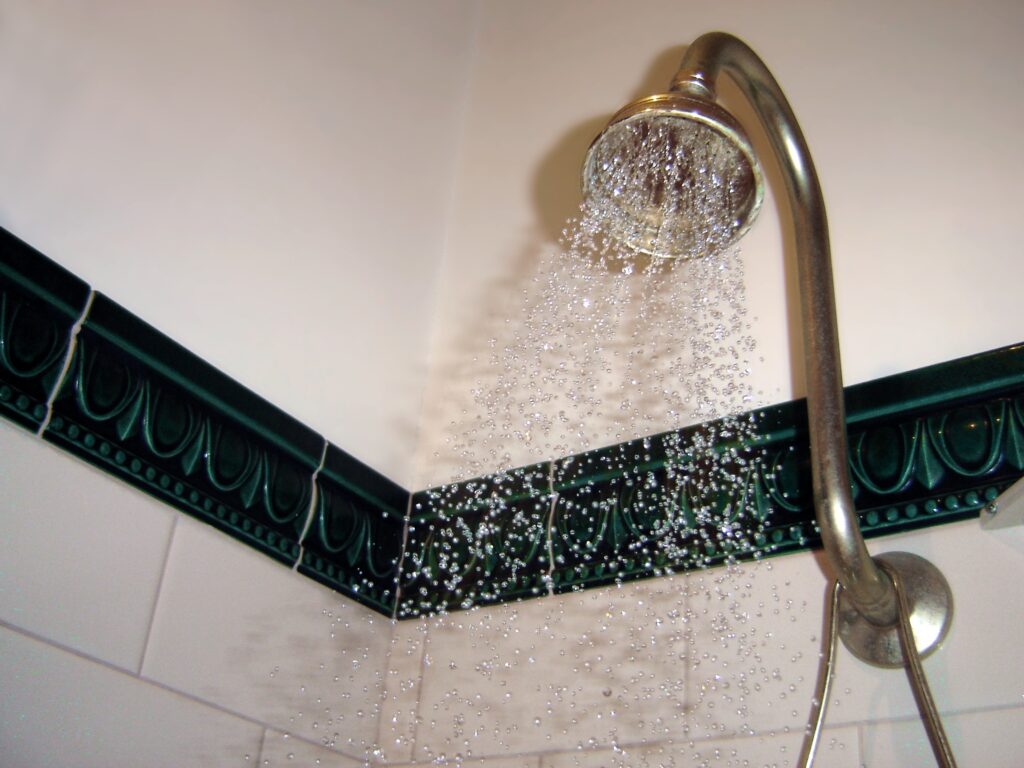
With the water off, check the spray selector and any pause control according to the manual. A partially selected setting can produce a different pattern from the one you expect. On a handheld unit, look for a kinked hose or a connection visibly under strain.
Inspect the nozzles for deposits. Use only the manufacturer’s recommended cleaning method and products. Do not assume an overnight vinegar soak is compatible with every finish, coating, seal, or internal component. A method suited to one faucet accessory may damage another.
Check a debris screen only if your showerhead model has one
Some showerheads include a removable debris screen at the connection to the shower arm. Delta explains that this screen catches larger particles before they reach the internal parts, and that a clogged screen can reduce flow. On models designed for removal, clean the screen as the manufacturer directs and reinstall it in the correct position.
Do not confuse a debris screen with a flow restrictor. Delta specifically distinguishes the two and warns that removing a flow restrictor can affect the product and may void the warranty. If your manual does not identify a removable screen, do not pry out an internal insert based on appearance alone.
Manufacturer references: Delta low-pressure shower troubleshooting. For shower-arm flow comparison, see Moen Standard Valve low-flow guidance. These procedures are model-dependent.
Keep the surface dry enough to stand safely while inspecting it. Do not balance on a tub edge or use excessive leverage on a shower arm. If an accessible head will not loosen as its instructions describe, stop before disturbing the concealed connection.
Watch surface cleaning on compatible silicone nozzles
Check the showerhead model before copying the motion. Hansgrohe’s QuickClean demonstration shows finger-rubbing of its flexible silicone nozzles. This applies to compatible nozzles, not every metal spray plate, coating, or removable cover. Turn the shower off and work only from a stable, safely reachable position.
Manufacturer source: Hansgrohe QuickClean explanation and original video. Open that page if the embedded player is unavailable. This is third-party footage, not a shower tested by The Home Fix Guide.
Recheck the same spray mode afterward. Surface cleaning does not service an inlet screen, a mixing cartridge, or household pressure controls. Do not drill openings or remove flow-control parts. Persistent weak flow, a wall leak, or unstable temperature calls for the model-specific checks below, not harder scrubbing.
When a head-removal test is appropriate
Some manufacturers use flow at the exposed shower arm to distinguish a head restriction from an upstream issue. For example, Moen’s PosiTemp troubleshooting separates shower-only symptoms from problems affecting both outlets. Its cartridge guidance is specific to that valve family, not all showers.
Only perform a removal test if your model’s instructions allow it and the head is safely accessible. Turn the shower off before removal, keep the arm from twisting, and direct any brief test flow into the shower enclosure. Avoid hot water exposure. Stop if water appears at the wall or a connection moves unexpectedly.
If these conditions cannot be met, skip the test and have a plumber inspect it. Do not remove cartridges or open concealed supply connections as an extension of this check.
Measure shower flow if you can do it safely
For a repeatable description, use the blank shower-flow record to keep the mode, volume, time and any skipped check together.
An optional catch-and-time check puts a number on the flow you feel. Skip it if the floor is slippery, the water temperature is unstable, the shower is leaking outside its enclosure, or you cannot collect the spray without climbing or lifting a heavy container. Leave the shower head installed; this is not a valve-disassembly test.
- Use a lightweight container with a known US-gallon or quart mark and a timer. Keep the drain clear.
- Select the usual spray mode and a comfortable water temperature. Start collecting only when the stream is stable and you can capture the whole spray safely.
- Time a small measured volume, then turn the shower off. Note the collected volume, seconds, spray setting, and whether another fixture was running.
Gallons per minute = gallons collected × 60 ÷ seconds. For example, 1 US quart is 0.25 gallon. Collecting that volume in 10 seconds calculates to 1.5 gallons per minute. This is an illustrative calculation, not a reading from a home we tested.
If spray misses the container, the estimate will be too low; skip the measurement if the spray cannot be captured safely. A result of 1.5 gpm does not by itself prove a blockage. Compare the model’s rated flow, the selected mode, and any previous measurement under similar conditions. The EPA’s WaterSense showerhead guidance describes both flow and performance criteria; a pressure gauge measures a different quantity.
Do not mistake an efficiency rating for a blockage
The EPA states that WaterSense-labeled showerheads use no more than 2.0 gallons per minute and meet performance criteria. A new efficient head may feel different from an older model even when functioning as designed.
Check the model’s rated flow and installation instructions. Do not drill out or remove flow-control components to chase a stronger spray. That can change the product’s intended operation and water use. If selecting a replacement, compare spray coverage, compatibility, and published performance rather than only a “high pressure” marketing label.
For a planning example, a head delivering 2 gallons per minute uses 16 gallons during an eight-minute shower. That is arithmetic, not a measurement of your bathroom. Actual delivery and shower length determine use. Our high-water-bill guide helps compare consumption before attributing a bill increase to one fixture.
Temperature changes need a different level of caution
If the water becomes unexpectedly hot, fluctuates sharply, or one temperature range has very little flow, stop testing by touch under the spray. Record the symptom from a safe position and contact a plumber or the manufacturer. Do not alter temperature-limit or anti-scald components to increase flow.
A valve diagnosis depends on the installed system. Identify its model from documentation or ask the manufacturer using photographs. The appearance of a handle alone is not enough to select a replacement cartridge across brands.
When to call a plumber and what to ask
Get help for moisture at the wall, damaged fittings, unsafe access, persistent low flow after approved cleaning, or a problem affecting both tub and shower outlets. Stop using the shower if it may be leaking into the wall. A wider concern about unexplained water use can also justify a water meter check, but that will not diagnose the shower valve.
Ask for a quote in USD that distinguishes an accessible showerhead replacement from valve service or work inside a wall. Confirm diagnosis, parts, labor, and any wall repair separately. There is no useful single price for all of these scopes, and this guide does not invent a national cost range.
Frequently asked questions
Will a new showerhead fix the problem?
It may help if the existing head is restricted or unsuitable. It will not necessarily solve an upstream supply or valve problem.
Should I clean the sink aerator too?
Only if the sink has its own flow issue. Our aerator cleaning guide covers that separate task.
What should I check after maintenance?
Check normal spray operation and visible connections for leaks. If performance is unchanged, keep your notes and seek model-specific diagnosis.
Research-based guide; see our editorial policy. Illustrative bathroom photo: Point3D Commercial Imaging on Unsplash.