How to test water pressure at home starts with a suitable water-rated gauge and a sound, accessible cold-water hose connection. With ordinary water use stopped, open the faucet slowly and record the stable reading in psi. Note the connection’s location and repeat under comparable conditions; one reading cannot diagnose a regulator, leak, or blocked pipe.
This is an observation guide for an accessible household connection. It does not cover pressure testing newly installed pipe, adjusting a pressure-reducing valve, or working on well-pump controls. Use a plumber if the connection is damaged, unfamiliar, or cannot be safely isolated.
Still choosing a test? Use the plumbing troubleshooting guide for weak flow to compare fixture-specific checks with a pressure measurement.
Pressure is different from the amount of water flowing
Pressure is measured in pounds per square inch, or psi. Flow rate is a volume over time, often gallons per minute. A faucet can have poor flow because of a local restriction even when the supply pressure is adequate. Portland Water Bureau explains this distinction in its household troubleshooting guide.
If only one tap is affected, begin with weak flow at one faucet. If only the shower is affected, use the shower-only flow checks. If many fixtures are weak, compare low water pressure throughout the house. If pressure drops mainly when several fixtures run, use the multiple-fixture pressure-drop guide. For repeatedly high readings, see high water pressure in a house; if a pressure-reducing valve may be involved, record its model and symptoms with the pressure regulator guide.
Bucket timing can measure flow at one outlet, but it cannot substitute for a pressure gauge. Conversely, a static gauge reading cannot tell you how many gallons per minute your shower will deliver.
Choose a suitable gauge and connection
Read the specifications before buying or borrowing a gauge. A large dial, a large connection, and a high maximum reading describe different features.
| Listing detail | What to confirm |
|---|---|
| Water service | The manufacturer permits the water temperature and pressure you will measure. |
| Connection | Match the stated thread type and size. Garden-hose thread is not pipe thread. |
| Dial size | This describes the face, not the faucet connection. Choose markings you can read clearly. |
| Pressure scale | Its maximum is the instrument’s range, not a recommended pressure for your home. |
| Maximum pointer | Useful for retaining a peak; check the live needle separately and follow the reset instructions. |
A documented example: Watts 276H300
Affiliate disclosure: We may earn a commission when you buy through the Amazon links on this page. As an Amazon Associate I earn from qualifying purchases.
The Watts 276H300 product page identifies ordering code 0069721. Check these details against your test point:
View Watts 276H300 on Amazon (paid link) — single gauge; check the 3/4-inch garden-hose connection against your test point.
On a narrow screen, scroll the table sideways to compare all columns.
| Documented feature | What to check |
|---|---|
| 3/4-inch female GHT connection | Match a garden-hose-thread outlet. Do not assume it fits pipe threads or a sink-faucet aerator. |
| 2½-inch dial; 0–300 psi scale | Check that you can read the increments you need. The scale maximum is not a recommended household pressure. |
| Maximum-retaining pointer; 40–140°F operating range | The pointer retains the highest indicated reading during the test. Confirm the temperature is within the stated range and follow the instructions for resetting and releasing pressure. |
Specifications checked October 11, 2026. This example is based on manufacturer documentation; we have not field-tested this gauge.
Use a gauge intended for water, with a readable range that covers the expected pressure and a connector matching the faucet. Many household test gauges use a 3/4-inch garden-hose connection. Garden-hose threads and pipe threads are different; do not force mismatched fittings together.
The Watts 276H300 instructions describe a hose-connection test gauge and a separate indicator that retains the highest reading. Check the instructions supplied with your gauge for its connection, temperature limits, and pressure-release procedure.
Choose a cold-water faucet that is accessible from stable ground, closes reliably, and has no signs of leakage or loose piping. Do not disconnect a washing-machine hose merely to make a test point. Do not use a water-heater drain for this homeowner check: hot water, sediment, and an unreliable drain valve introduce unnecessary complications.
Know where your household shutoff is before attaching a gauge. If the chosen outdoor faucet is already leaking or may have freeze damage, have it assessed instead of using it for a test.
Know which part of the plumbing you are measuring
An outdoor faucet may connect before the home’s pressure regulator, after it, or on a separate branch. The location determines what the reading can tell you. A high reading at an upstream hose faucet does not prove that every indoor fixture receives that pressure.
Look at existing plumbing records or ask a plumber to identify the route. Do not remove insulation, cut walls, or open a regulator to trace it. If the route is unknown, write “before or after regulator unknown” on the log. That is better than making a confident but unsupported diagnosis.
Homes using a private well, shared building supply, booster pump, or multiple pressure zones require extra context. Record the system type and let the responsible technician interpret pressure changes. Do not adjust a well pressure switch or expansion tank based on this guide.
Already have a pressure gauge in the house?
First identify what it measures. A gauge on a boiler, heating loop, or other appliance is not automatically a reading of the water supplied to your faucets. If its purpose or connection is unclear, photograph the label and ask the responsible technician; do not open a valve or adjust equipment to obtain a reading.
For a gauge confirmed to measure the household water supply, record its location, units, and whether it is before or after a pressure regulator. Read the current-pressure needle separately from any maximum indicator. The Watts test-gauge instructions, for example, describe a separate pointer that retains the highest reading.
A label such as “60 psi, basement supply gauge, no fixtures running, regulator position unknown” is more useful than “water pressure is 60.” A suspicious or unchanging gauge should be checked by a professional before its reading is used to justify repairs.
How to test water pressure at home with a gauge: five safe steps
First identify a compatible water-rated gauge, a sound cold-water connection, and the correct pressure-release method as described above. Follow your gauge’s complete instructions; do not use an unfamiliar or leaking test point.
- Stop ordinary water use. Tell the household you are measuring. Wait for toilet refill and avoid showers, laundry, dishwashing, and scheduled irrigation. Do not disable fire protection or other safety systems.
- Attach the gauge with the faucet closed. Inspect the gauge’s sealing washer. Fit and tighten it as the manufacturer directs, without twisting the faucet or connected pipe.
- Open the faucet slowly. Watch for leakage at the fitting or stem. Close it and stop if a leak develops, the pipe moves, or the reading approaches the gauge’s limit.
- Read the live pressure needle. Allow it to stabilize, then record the psi, time, and exact connection. Distinguish a live needle from a retained-maximum pointer.
- Finish according to the gauge instructions. Close the faucet, release trapped pressure using the prescribed method, and only then disconnect. Never unscrew a connection under pressure. If the release procedure is unclear, get help.
Stay beside the gauge during this basic check. Do not leave an outdoor connection pressurized and unattended or allow the assembly to freeze. Confirm that the faucet is fully off and dry when you finish.
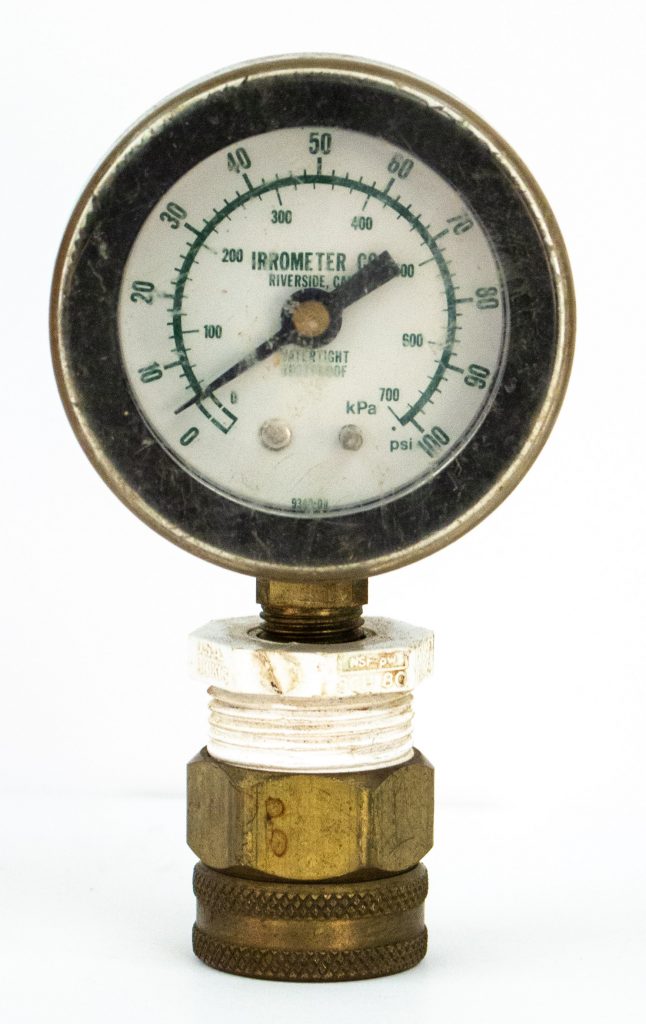
Watch the live pressure reading at a hose faucet
1-Tom-Plumber demonstration, excerpt approximately 2:32–3:05. The gauge is already attached; the presenter confirms no household water use, opens the faucet and reads the live needle. The displayed reading is an example, not a target for every home. Read the five attachment, reading, and pressure-release steps above before using this video example. This excerpt does not cover or recommend adjusting a regulator. Watch the source video on YouTube.
| Mark or feature | How to use it |
|---|---|
| psi scale | Read pressure on the scale labeled psi; do not mix it with a bar or kPa scale. |
| Current-pressure needle | Record the stabilized value while the test conditions are known. |
| Retained-maximum pointer, if fitted | It records a peak on applicable models; it is not a second live reading. Reset only as the manufacturer directs. |
| Connection location | Record whether it is before or after a regulator, or write “unknown.” |
The Watts 276H300 instructions illustrate a hose-connected gauge with a retained-maximum indicator. Use the procedure for the exact gauge in your hand, including how to release trapped pressure before disconnection.
Static vs. flowing water pressure: label both readings
Static pressure is the reading with no water flowing in the system being checked. Hunter’s residential measurement guidance uses a hose-connected gauge with other household water use stopped. If automatic equipment runs, record the interruption rather than labeling the reading static.
Flowing pressure is the pressure at the gauge while a specified fixture is using water. Keep the gauge at the same test point and label which fixture was open. This remains a pressure reading in psi, not a measurement of gallons per minute. Portland Water Bureau explains why pressure and flow are different.
Read the example below as a sequence: 56 psi before water use, 43 psi with the kitchen faucet open, then 56 psi after it closes. The 13 psi difference describes these invented test conditions; it is not a universal pass/fail limit or proof of a bad regulator. This optional comparison is for a safely accessible connection and a normally draining fixture, using the precautions below. Do not adjust equipment to reproduce these values.
Keep the conditions with the number
Repeat at a comparable time if the first result is surprising. A later reading can help show whether the change is consistent. Do not repeatedly reconnect a fragile faucet; let a plumber use a suitable test point.
| Condition | Reading | Context to record |
|---|---|---|
| No ordinary fixtures running | 56 psi | Front hose faucet; regulator position unknown |
| One cold faucet running normally | 43 psi | Same gauge connection; kitchen faucet open |
| Cold faucet closed again | 56 psi | Reading returns to the earlier value |
The example shows why the conditions belong beside the number. A pressure drop while water is flowing is not automatically a fault. If you make this optional comparison, use only a normally draining fixture, have another adult operate it, and stop if leakage or other unsafe behavior appears.
A retained maximum can reveal that pressure was higher at some point. It does not establish the duration or cause of that peak. The gauge cannot, by itself, identify thermal expansion, utility variation, or a regulator problem. Give the complete log to the professional interpreting it.
How to interpret a high or low reading
Compare the result with your utility’s expected supply range and the requirements of the equipment downstream. There is no single ideal reading for every house. As one local example, Portland says it aims to keep most homes between 40 and 80 psi; that is not a nationwide guarantee for your address.
Arrange an assessment for repeated readings above 80 psi, a marked change from the home’s established pressure, or pressure outside a fixture’s stated limits. Kohler’s pressure guidance illustrates why product-specific limits matter. Confirm applicable requirements with your local authority and installer rather than treating a fixture’s test range as a setting for the whole house.
If pressure and flow changed throughout the home, ask the utility about nearby work or supply problems. If water loss is suspected and there is no active emergency, a water meter leak test answers a different question: whether metered water is being used when ordinary uses are stopped.
If cold flow seems normal but hot water is weak, use the hot-versus-cold flow comparison to record which outlets are affected. A cold-side gauge reading alone does not locate a hot-side restriction.
When to call for service and what to budget
Call promptly for active leakage, violent pipe movement, or a sudden major loss of supply. For persistent abnormal readings, ask a licensed plumber to verify the test location, gauge accuracy, regulator behavior, and relevant equipment. Do not turn a regulator adjustment screw until the system has been identified.
A basic observation may require only purchasing or borrowing a suitable gauge. If professional testing is needed, request a USD estimate for diagnosis separately from regulator replacement, expansion-control work, or pipe repairs. Ask whether a second test location or longer monitoring period would answer the remaining question before approving replacement parts.
Frequently asked questions
Does a normal static reading rule out a flow problem?
No. A restriction can become noticeable when water is moving. Record which fixtures are affected and the conditions under which the symptom occurs.
Can I lower pressure by partly closing the main valve?
Do not use the household shutoff as a pressure regulator. Ask a plumber about the appropriate pressure-control equipment and its condition.
Is the red pointer the current pressure?
Not necessarily. Some gauges use it to retain a maximum. Read the gauge’s instructions before recording or resetting a pointer.
Featured photo: Imani on Unsplash. Stock faucet image illustrates household water use; it is not a pressure measurement.