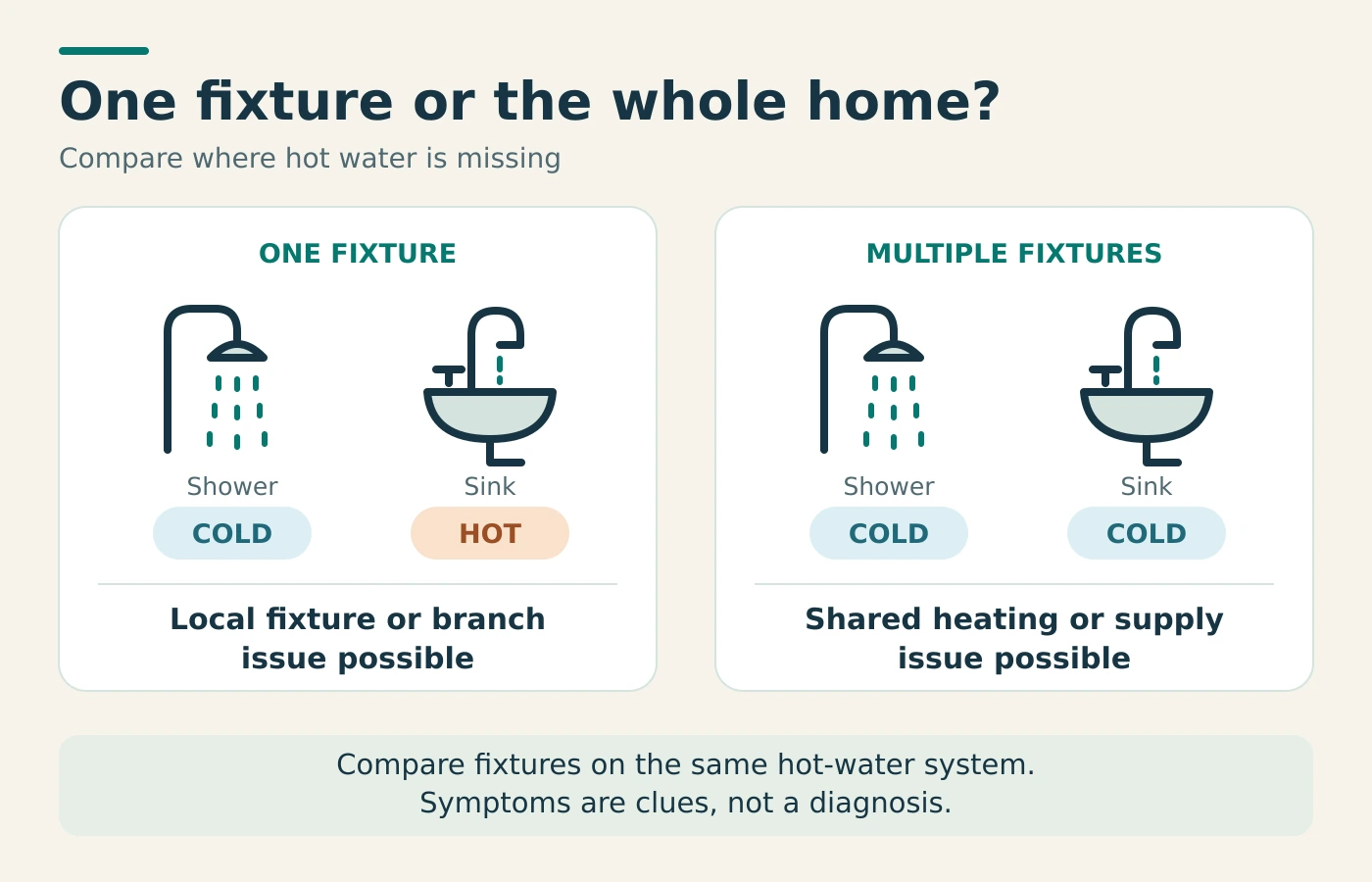
If water flows normally from the hot tap but stays cold, first work out whether it affects one fixture or the whole home. Then distinguish water that never gets hot from water that starts hot and runs out. Those patterns lead to different checks; none identifies a failed part on its own.
Featured image: AI-generated illustration in a photographic style, not a photograph of an inspected installation.
This guide helps you narrow a no hot water problem without opening a water heater or handling gas, wiring, or safety controls. If the hot side barely flows or produces no water, use our low hot water pressure guide instead. A temperature problem and a flow problem can occur together, so record both.
If you smell gas, leave immediately without operating switches, appliances, or a phone indoors. Call the gas utility or 911 from outside. If a carbon monoxide alarm sounds, go outside to fresh air and call 911; do not reenter until emergency responders say it is safe. Keep away from leaking water near electrical equipment. Do not open heater panels, relight a pilot, repeatedly reset a breaker, test a relief valve, or block a discharge pipe.
Start with the symptom, not a replacement part
“No hot water” can describe several different failures. Use what you have already noticed during ordinary use; you do not need to stand in a shower or expose your hands to a potentially hot stream to confirm the problem.
| What you notice | What it helps separate | Best next step |
|---|---|---|
| One shower or faucet stays cold; another fixture gets hot as usual. | A local fixture or branch problem from a complete loss of home hot water. | Go to one affected fixture. Record its brand and model. |
| Normal flow, but multiple hot taps never warm up. | A shared supply/heating issue from a single fixture issue. | Check whole-home clues and identify the system. |
| Water starts hot, then becomes cold sooner than usual. | Hot-water availability or recovery from water that never heats. | Use the runs-out comparison. |
| Water stays lukewarm at several fixtures. | Partial heating, operating settings, or mixing possibilities. | Record the pattern and visible display; do not turn up the temperature to mask it. |
| Hot-side flow is weak or absent, even though cold flows normally. | A flow restriction or supply problem. | Follow weak hot-water flow troubleshooting. |
| Neither hot nor cold flows at several fixtures. | A broader water-supply interruption. | Use no water coming out of faucets. |
No hot water at one shower or faucet
If the fixtures share the same hot-water system and another fixture still supplies hot water normally, that system is producing at least some hot water. Homes with separate point-of-use heaters need each system considered on its own. That makes replacing the heater an inappropriate first conclusion. A local mixing valve, cartridge, fixture adjustment, or branch supply issue may need investigation.
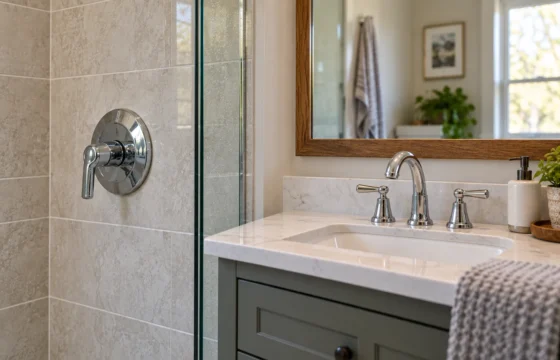
Moen’s single-shower troubleshooting starts by confirming that the home’s hot-water system works and identifying the valve model. The relevant components and adjustments vary by design. A shower handle position is not a reliable diagnosis, and a similar-looking cartridge is not necessarily the correct part.
- Compare locations: note whether a nearby sink gets hot while the shower does not, or whether an entire bathroom is affected.
- Record recent work: a new faucet, cartridge replacement, bathroom remodel, or supply interruption is useful context.
- Identify the fixture: photograph visible brand markings and the handle/trim without removing them.
- Arrange model-specific help: contact the manufacturer, installer, or plumber. Leave trim removal, cartridge work, and anti-scald adjustment to appropriate service.
For a shower-specific comparison, see no hot water in the shower but sinks are hot.
Do not adjust a shower’s temperature limit to compensate for a fault. An incorrect adjustment can change the scald protection. If temperatures swing unexpectedly, stop using that fixture until the cause is addressed.
No hot water anywhere: gather these clues first
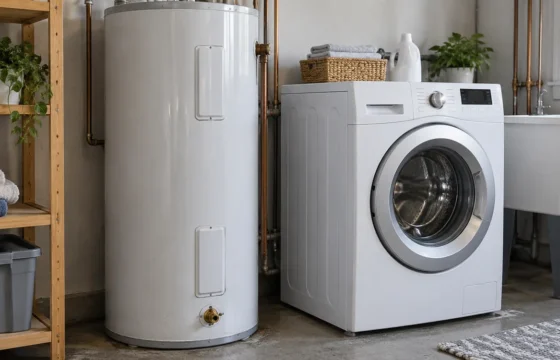
Before looking at the heater, check whether your home has its own unit. In an apartment or condo with shared hot water, ask building management about an outage or maintenance. Do not enter a locked equipment room or operate shared equipment.
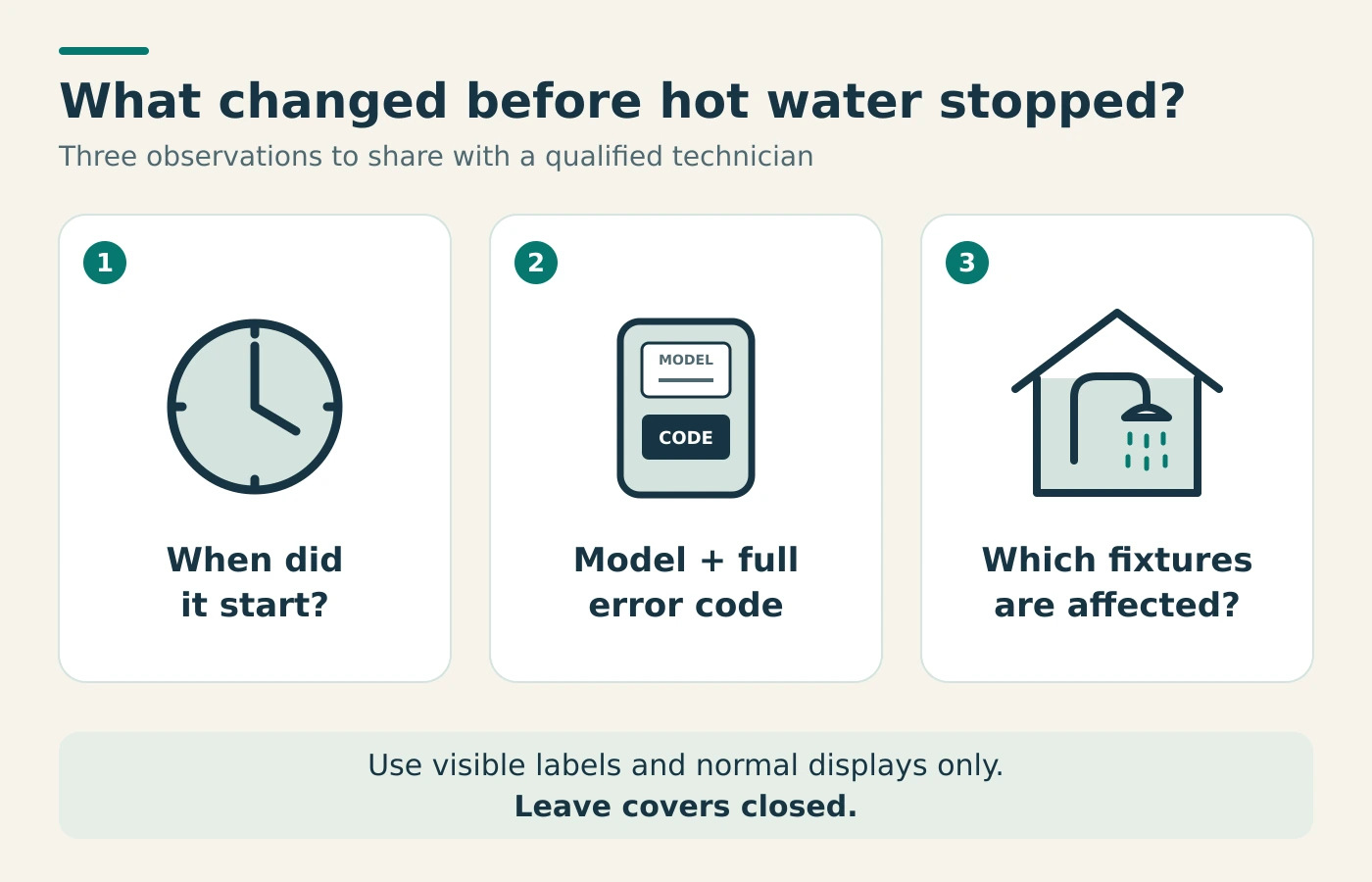
- Establish the timing. Did hot water stop suddenly, after a power outage, after service, or gradually over several days? Was it working before several consecutive showers?
- Identify the system from a safe position. Use the installation paperwork or an accessible external label. Record the model, not just the brand. Do not remove covers to find it.
- Read the normal external display. Photograph any message, mode, schedule, or error code before changing anything. A blank display alone does not identify the failed part.
- Check known interruptions. Consult an already reported electric or gas utility outage or building notice. Do not operate gas valves or disturb electrical equipment to test the supply.
- Use the exact model manual. Find the manufacturer’s instructions for that model and its customer support contact. Limit yourself to the manual’s normal, accessible user controls; fault diagnosis belongs with qualified service.
If you already know a breaker has tripped, report that information. This guide does not call for opening an electrical panel or resetting it. Repeated trips, burning smells, scorching, unusual heat, or water around electrical equipment are reasons to stop and get professional help.
What your water-heater type changes
The same cold-water symptom does not mean the same repair across systems. The table below gives useful observations, not instructions for testing components.
| System | Useful information to record | Leave to qualified service |
|---|---|---|
| Electric storage tank | Model, recent power interruption, any visible external status, whether water never heats or runs out early. | Heating-element and thermostat diagnosis, wiring, internal reset controls, and cover removal. |
| Gas storage tank | Model, external status light/code, known utility interruption, and when the symptom began. | Ignition/pilot work, gas supply tests, combustion, venting, and burner service. |
| Heat-pump or hybrid tank | Displayed operating mode, schedule, error message, recent mode changes, and heavy hot-water use. | Internal electrical, refrigerant, compressor, and control diagnosis. Follow the model manual for operating limits. |
| Tankless water heater | Exact error code, whether every fixture is affected, whether it happens during low-flow use, and simultaneous demand. | Gas/electrical tests, internal filters and valves, descaling, venting, and internal repairs. |
| Boiler-linked, indirect, or shared building system | Whether space heating is also affected, building notices, and accessible controller messages. | Boiler settings, pumps, shared valves, and equipment-room controls. |
For heat-pump water heaters, operating mode can affect recovery. US Department of Energy guidance explains mode-dependent recovery and vacation operation. Record the current mode rather than assuming that every setting provides the same hot-water availability.
Tankless water stays cold only during a small draw
Some tankless units need a minimum flow to activate and keep heating. Rinnai’s manufacturer FAQ describes this behavior, but a threshold from one product family should not be applied to another model. Record whether the symptom happens only with a small trickle or at one fixture, then check the exact manual or contact support.
Do not remove flow restrictors, raise the temperature, or bypass a safety device to force activation. If a code is displayed, include the model and full code together. A code number without its model can lead to the wrong advice.
Video: how a water heater works
This short A. O. Smith process explainer is published by HD Supply. It provides background on heating and hot-water delivery; it is not a diagnosis of your no-hot-water problem or a repair procedure for your model. Keep covers closed and use the safe observations above.
Source: HD Supply water-heater resources. Watch the 1-minute-47-second video on YouTube if the embedded player is unavailable.
Water starts hot, then runs cold
This is a different observation from water that never heats at all. A storage tank has a limited supply of heated water and needs time to recover after use. The useful question is whether today’s behavior matches the home’s usual demand or represents a new change.
- After unusually heavy use: note the number of showers and whether a dishwasher or washing machine was also using hot water. Pause avoidable hot-water use and use the model manual’s recovery guidance before judging the next normal use.
- During ordinary use that used to work: record roughly how long hot water lasted and whether the change was sudden. A heating, control, mixing, or delivery problem needs diagnosis rather than a guess at one part.
- Only when several fixtures run: record the combination. If the stream also weakens, the flow behavior matters separately from the temperature loss.
- After a mode or schedule change: record the displayed setting and compare it with the manual. Do not change unfamiliar installer settings.
For a demand log and storage-versus-tankless checks, see hot water runs out quickly.
If the water eventually reaches its usual temperature at normal flow but you wait for it to arrive, see hot water takes too long to reach the faucet for delivery-delay patterns and distribution options.
There is no universal recovery time for every heater. Tank size, heating method, operating mode, incoming water, and demand matter. Likewise, a tankless unit does not have an unlimited heating rate just because it has no storage tank.
Do not use a higher temperature setting as a shortcut. It can increase scald risk and may conceal the actual problem. Temperature selection should follow the unit’s instructions and the household’s needs, with professional advice where appropriate.
When to call, and what to tell the service person
Arrange qualified service when several fixtures stay cold without a known outage, the problem returns, a fault message persists, normal-use hot-water availability has changed, or a single fixture has unpredictable temperatures. Contact the installer first for a newly installed unit and ask about warranty service before buying parts. Renters should notify the landlord or property manager through their maintenance process.
A leak, scalding temperature, persistent electrical trip, soot, or damaged venting changes the priority: stop troubleshooting and keep people away. Gas odor or a carbon monoxide alarm requires the emergency response described above, not a routine repair appointment.
- First noticed / last normal use:
- One fixture, several fixtures, or the whole home:
- Flow normal, weak, or absent:
- Never warms / lukewarm / starts hot then runs cold:
- Heater type, brand, and exact model:
- Full displayed code or status message:
- Recent outage, plumbing work, mode change, or unusual demand:
- Leaks, odors, alarms, or other safety concerns:
A. O. Smith’s repair guidance also recommends consulting the model’s owner’s manual and recognizes that a single cold fixture can involve its mixing valve. Those clues narrow the conversation; they do not establish a repair estimate or prove the heater needs replacement.
Common questions
Why does the sink get hot but the shower stays cold?
If both fixtures share one hot-water system, the system is producing some hot water; investigate the shower’s local supply and mixing controls with its exact model information. If they use separate heaters, a hot sink does not establish that the shower’s heater works. A cartridge or adjustment is a possibility, not a confirmed diagnosis. Avoid removing parts or changing anti-scald settings based on a generic video.
Should I reset the water heater if there is no hot water?
Not as a general troubleshooting step. Different systems have different controls, and an internal safety reset may signal a condition that needs service. Record visible messages and follow model-specific support rather than opening covers, pressing internal resets, or repeatedly cycling power.
How long should I wait for hot water to return?
Use the manual’s recovery guidance after a known heavy-use period or restored service. There is no single wait time that diagnoses every system. If the cause is unknown, or hot water does not return as expected for that model, contact service rather than repeatedly running taps.
Does no hot water mean I need a new heater?
No. The problem could involve a local fixture, an interruption, operating controls, or equipment that needs repair. Age and symptoms alone do not identify the failed part. Have the cause and available repair options established before deciding on replacement.
Sources and scope
This is a research-based troubleshooting guide for US households, not a report of hands-on testing or a substitute for the instructions supplied with your equipment. It covers safe observations and escalation, not gas, electrical, plumbing-disassembly, or safety-device repair procedures.
- US Consumer Product Safety Commission: gas-leak safety — leaving the building and calling from a safe location.
- CPSC: carbon monoxide fact sheet — response to a CO alarm.
- A. O. Smith: water-heater repair considerations — model manuals and single-fixture troubleshooting context.
- Moen: no hot or no cold water at a tub/shower — identifying the valve and checking the home’s hot-water supply first.
- US Department of Energy: residential water heaters — heat-pump operating modes and recovery.
- Rinnai: residential FAQs — model-dependent tankless activation and flow behavior.