If hot water takes too long to reach a faucet but eventually reaches its usual temperature at normal flow, start by comparing when and where the delay happens. A long pipe run can leave cooled water between the heater and the tap. A delay that suddenly gets worse deserves a different response from a distant bathroom that has always taken longer.
Featured image: AI-generated illustration in a photographic style, not a photograph of an inspected installation.
This guide covers the wait before usable hot water arrives. If the water never heats up, use no hot water: one fixture or the whole house. If it starts hot and then cools, see hot water runs out quickly. A weak hot stream belongs in the low hot water pressure guide.
Which delay pattern do you have?
| During normal use | Useful next step |
|---|---|
| A distant sink has always been slower, especially after hours without hot-water use | Discuss the distribution route and water left in the pipe with a plumber. |
| The same faucet is suddenly much slower than before | Record the change and any recent work; arrange a targeted check. |
| Several outlets on the same hot-water system changed at once | Report the whole-home pattern, heater model, and any visible display code. |
| A previously quick system is now slow, and it has recirculation | Note whether the usual schedule or demand control appears active. Have its operation checked. |
| The water remains lukewarm, never heats, or the stream is weak | Switch to the matching symptom guide above rather than assuming a long pipe run. |
Why the pipe between the heater and faucet matters
After a hot-water draw ends, water remains in the supply piping and loses heat. On the next draw, that cooled water is displaced before newly heated water reaches the outlet. The actual plumbing route matters more than the straight-line distance across a room: a pipe may travel through a basement, wall, or shared trunk before reaching the faucet.
Longer runs and larger internal pipe diameters hold more water. The Department of Energy’s explanation of compact plumbing describes how shorter distribution paths reduce this stored volume. A heater can therefore be producing hot water while a distant tap is still delivering the cooled water ahead of it.
That mechanism can explain a repeatable, longstanding delay. It does not prove that a new problem is harmless, and it does not establish a universal acceptable wait.
A small volume can create a noticeable wait
For illustration, the DOE-sponsored tankless-water-heater measure guide, section 2.4, gives an example of 0.46 gallon in a pipe and a flow of 1 gallon per minute. Dividing volume by flow gives about 28 seconds to displace that water.
This is a simplified volume calculation, not a pass/fail test for your faucet. Heater startup, heat transfer, mixing, and the actual hot-side flow can change the observed wait. Do not run extra water to recreate the example, remove a flow restrictor, or resize piping based on it.
Three observations worth writing down
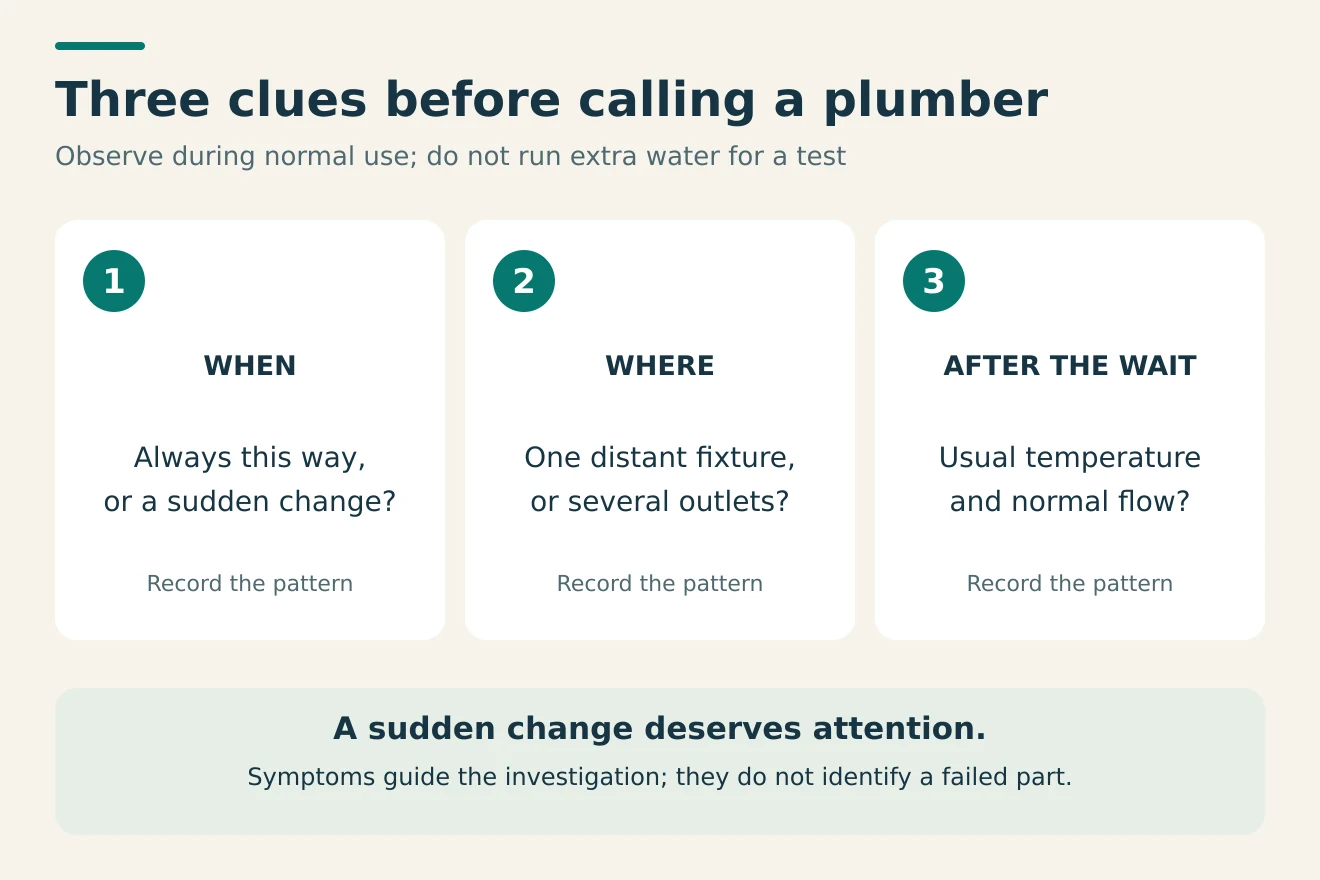
- What changed? Record whether this is longstanding or new, and whether it began after heater service, a faucet replacement, a power interruption, or a change to a recirculation control.
- Where does it happen? Note the affected fixtures during their usual use. Compare outlets served by the same heater; a separate point-of-use unit or separate apartment system changes the comparison.
- What happens after the wait? Does the water reach its familiar temperature and remain steady, or stay lukewarm, fluctuate, or cool again? Note whether the flow feels normal. Do not use your hand as a thermometer or deliberately expose yourself to hotter water.
A useful service note might be: “The upstairs bathroom used to warm up during my normal morning routine. Since last week’s service it takes noticeably longer. The kitchen seems unchanged, and the bathroom eventually gets as warm as before.” This gives the plumber a before-and-after comparison without guessing which component failed.
If you rent or share a central hot-water system, give this record to the property manager. Avoid changing shared equipment or controls.
Will switching to tankless make hot water arrive immediately?
Not by itself. A tankless unit still sends water through the distribution piping. Rinnai’s delivery-time explanation emphasizes the distance from heater to fixture. Its recirculation options are separate system features, not a benefit every tankless installation automatically provides.
The DOE measure guide also describes a startup sequence before a tankless heater begins heating. The relevant question for an installer is how the whole system will deliver water at your troublesome fixture. Replacing a working heater solely because a distant faucet is slow can leave the underlying pipe route unchanged.
Which improvements are worth discussing?
Pipe insulation: reduce heat loss
DOE’s pipe-insulation guidance explains that insulation reduces heat escaping through piping. It may help water retain warmth between uses, but it does not remove the water stored in a long run. After a sufficiently long idle period, a wait can remain. Ask about appropriate materials, access, and required clearances rather than wrapping unfamiliar equipment yourself.
Demand-controlled recirculation: move cooled water through a return path
A recirculation system can bring hot water closer to fixtures before a draw. DOE’s on-demand recirculation overview favors demand-initiated pump controls. Discuss water savings alongside pump electricity and heat lost from warm piping; reduced waiting does not guarantee lower total energy use.
Compatibility matters. Rinnai’s accessory information describes built-in or added pumps and configurations that use a thermal bypass where there is no dedicated return line. These are model- and plumbing-specific choices. Ask the installer which return path is proposed, how the controls work, and whether cold-tap behavior will change. This is not a universal add-on or a DIY installation guide.
A shorter route: mainly a design or renovation decision
When walls are already open or a major remodel is planned, ask whether the heater location or pipe routing can be improved. Have a qualified professional determine code-compliant pipe sizing and adequate flow. A shorter wait alone is not a reason to reduce pipe size without a design check.
Video: a manufacturer example of recirculation
Watch Rinnai America Corporation’s “How Rinnai’s ThermaCirc360™ Recirculation Works”. The exact video is also listed on Rinnai’s official video resource page. It illustrates one manufacturer’s approach; it is not a compatibility check, a promise of zero waiting, or an installation recommendation for your home.
When to arrange professional help
Book a check when the delay changes abruptly, follows installation or service, affects several fixtures, or persists with a known recirculation system that previously worked well. Stop treating it as a simple delivery delay if the water becomes dangerously hot, fluctuates sharply, or never reaches its usual temperature.
Before approving work, ask the plumber to separate the diagnosis from the proposed upgrade. Request the affected fixture, expected improvement, compatibility requirements, control method, and a written installed price in USD. Ask what water and energy tradeoffs remain and how the result will be verified. A pump quote and a pipe-rerouting quote solve different problems.
Frequently asked questions
How long is too long to wait for hot water?
There is no single diagnostic time limit for every home. The useful comparison is your usual pattern, the fixtures affected, and whether normal temperature and flow eventually return. A new change should be investigated even if another home has a longer wait.
Why is the first use of the day slower?
Water left in the pipe has had more time to cool. That is a plausible explanation when the pattern is consistent, but it should not be used to dismiss new loss of heat or a change in flow.
Should I turn up the water heater?
Do not raise the temperature to diagnose a delivery delay. It does not shorten the pipe route and can make exposure to hot water more hazardous. Have temperature concerns assessed using the model’s instructions and appropriate safeguards.
Should I run several hot taps to get hot water faster?
This guide does not recommend that as a test or daily workaround. It uses extra water and changes the demand on the system. Observations from normal use are enough to prepare a service visit.
Prepared by The Home Fix Guide Editorial Team. Sources checked October 1, 2026. The illustrations are original conceptual diagrams, not installation plans or photographs of completed work. Read our Editorial Policy and Disclaimer.