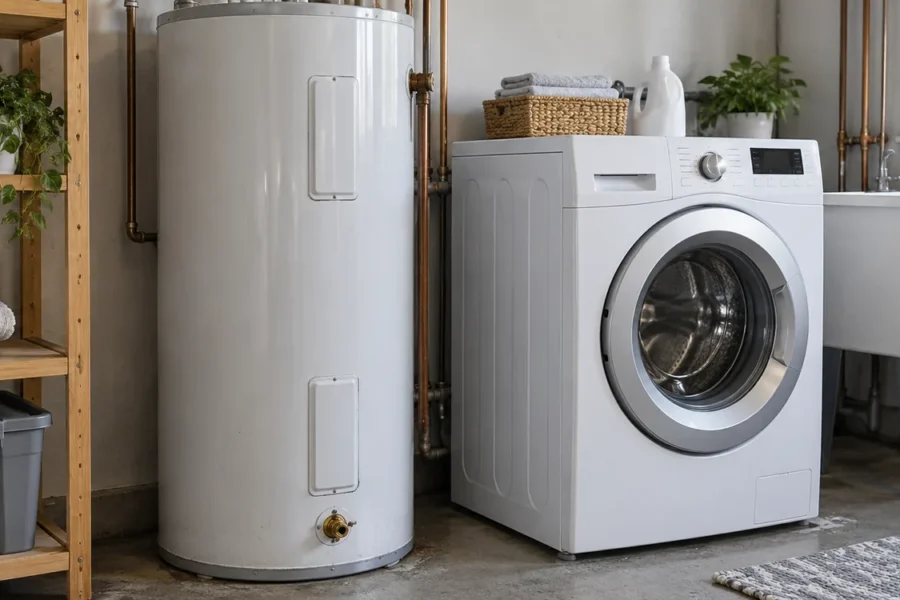
If water starts hot but turns cool sooner than usual, first separate high demand from a change in the system’s performance. Note whether several fixtures lose warmth, what used hot water beforehand, and whether the problem repeats after a normal recovery period. A short shower alone does not identify a failed part.
Featured image: AI-generated illustration in a photographic style, not a photograph of an inspected installation.
This guide focuses on water that starts hot and runs cold. If it never gets hot, begin with no hot water: one fixture or the whole house. If the stream becomes weak instead, use low hot water pressure with normal cold flow. If the water eventually reaches its usual temperature after a wait, use the hot-water delivery delay guide for that arrival-delay pattern.
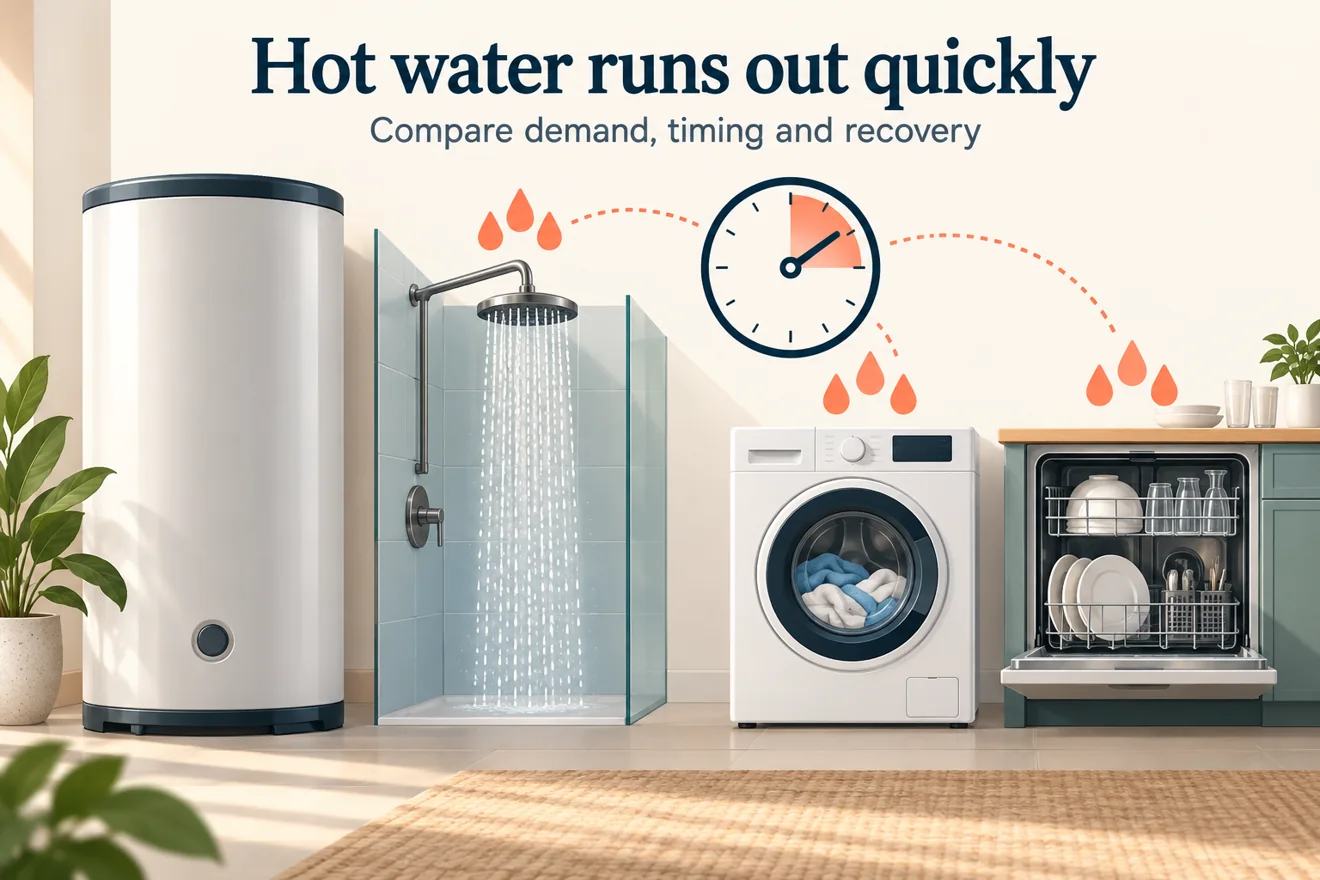
Choose the pattern that matches your home
| Observed pattern | Useful next step |
|---|---|
| Only after back-to-back showers, baths, or appliance use | Compare with a day when hot-water use is spaced out. |
| Much shorter hot-water duration with the same household routine | Arrange a model-specific performance check. |
| Only one shower cools while other outlets remain hot | Use shower cold but sinks hot to prepare a local valve and supply investigation. |
| Tankless water turns cold intermittently, especially at low flow | Record the flow pattern and display code for the installer. |
| Problem started after installation or service | Contact the installer with the date, model, and before/after behavior. |
A storage tank can be depleted before it recovers
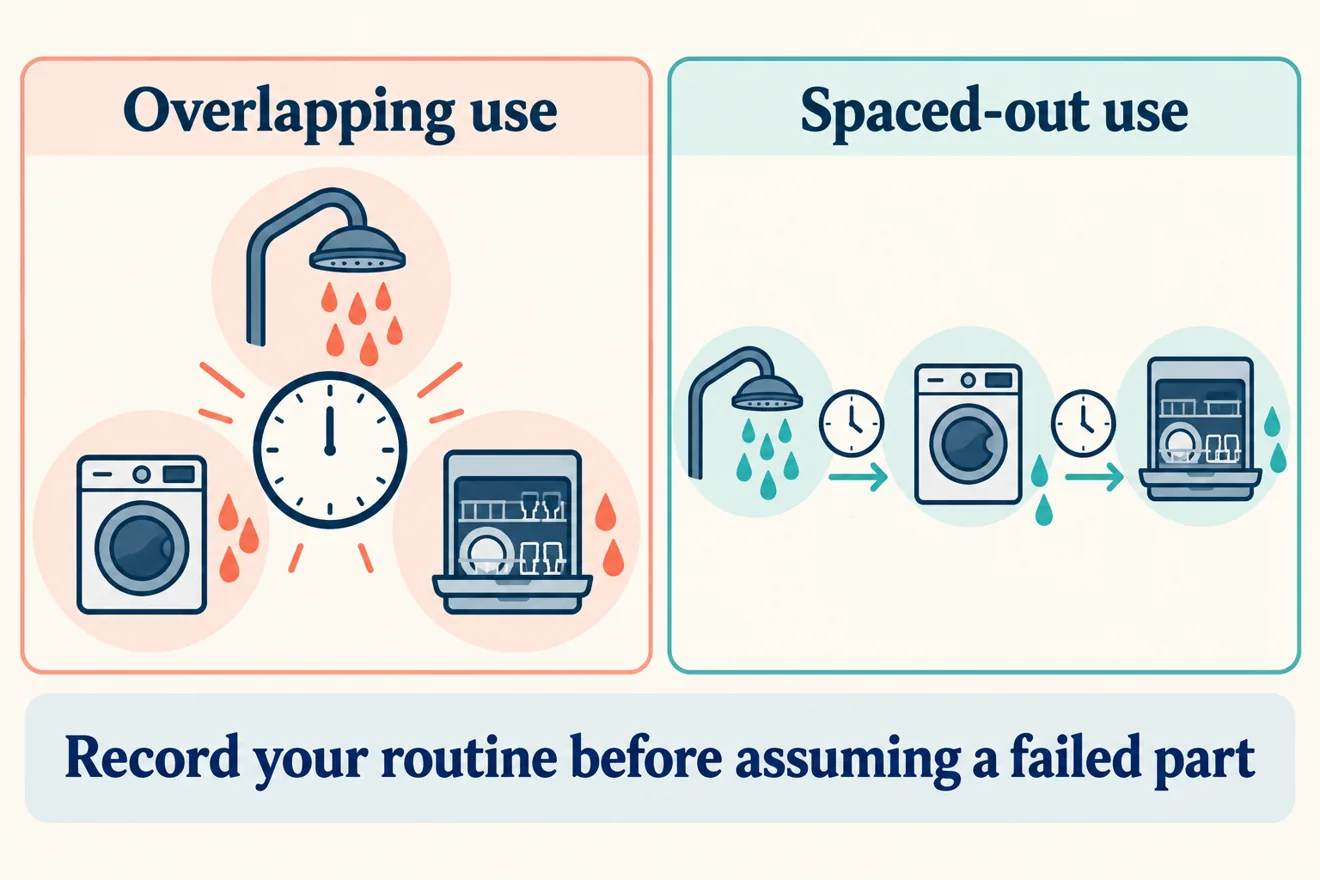
Storage water heaters have a finite supply of heated water and take time to reheat incoming water. Rheem’s explanation of inconsistent hot water identifies overlapping use, recovery, and colder incoming water as contributors. These can make an otherwise familiar routine use up the available supply sooner.
Write down recent use before buying parts: a bath, longer shower, guests, laundry, or a dishwasher cycle. Compare one ordinary use after the heater’s normal recovery period with the crowded morning routine. You do not need to deliberately run the tank cold. If spacing use resolves the symptom, that supports investigating demand and capacity; it does not certify that every component is healthy.
There is no universal “a 40-gallon tank should give exactly this many shower minutes” rule. The water mixed at a shower is not all drawn hot from the tank, and the heater may be reheating during use. Read the model’s performance information rather than dividing the tank label by a showerhead number.
Use first-hour rating when discussing capacity
ENERGY STAR defines first-hour rating as the estimated hot-water volume a storage heater can deliver in an hour beginning fully heated. It is a standardized performance measure, not a promise for every household routine.
Ask the installer to compare your busiest hour with the existing unit’s first-hour rating and recovery characteristics. ENERGY STAR’s gas-storage guidance recommends considering both storage volume and first-hour rating. A capacity assessment should come before a recommendation to buy a larger tank.
If the same routine now runs cold sooner
A persistent change without increased use warrants service rather than a guess about tank size. Depending on the equipment, a technician may need to check heating controls, heating performance, the water path, and mixing components.
- Electric storage heater: A heating-element or control problem can leave some hot water available while reducing useful delivery. A. O. Smith’s electric-heater bulletin describes a controlled performance test and, depending on the results, investigation of thermostats, the lower element, and dip tube. Those are service procedures, not a diagnosis from shower duration.
- Gas storage heater: Have a qualified technician check whether heating and recovery are operating as intended. Do not adjust gas supply, burner parts, venting, or combustion controls.
- Sediment or scale: Rheem notes that buildup can impair heating performance. Noise or age alone does not establish the cause. Maintenance must follow the model’s instructions; an improvised flush is not the first diagnostic step.
Photograph the model label and display only if accessible from a dry, safe position. Record the shown mode or schedule without changing it. For a heat-pump water heater, operating mode matters: ENERGY STAR notes that hybrid operation can use auxiliary resistance heating during high demand. Ask the manufacturer or installer whether the observed mode fits the household’s needs.
Tankless systems need a different investigation
A tankless heater is not running out of a stored tankful. It must operate within its model’s flow and temperature-rise capability. ENERGY STAR’s criteria distinguish tankless delivery in gallons per minute at a specified temperature rise from storage first-hour rating.
There is also a minimum operating flow. Rinnai explains that flow below its units’ minimum can stop heating. Therefore, “it turns cold when the shower is barely open” and “it turns cold when several fixtures run” are different reports. Do not assume either proves a clogged filter or undersized heater.
Record whether the change follows a pause, a handle adjustment, or another fixture starting. Photograph any error code before contacting the installer. Avoid repeated resets or using an extra running faucet to keep the heater firing. Let a qualified service provider assess the model, installation, flow, and maintenance needs.
A simple hot-water log for your service call
Use normal household activity, not a prolonged drain-down test. Keep people out of water that could change temperature unexpectedly.
- Describe the baseline: “Previously enough for two usual showers; now the first becomes cool.” Approximate timings help, but do not invent precise measurements.
- List preceding use: fixtures, appliances, and roughly when they ran.
- Note scope: one shower only or several outlets, and whether flow stays normal.
- Record recovery: does ordinary hot water return after the model’s usual reheating interval? There is no single wait time for all heaters.
- Add changes: guests, weather, new fixtures, service, operating mode, display codes, or visible leakage.
Example: “Since last week, our usual first shower starts hot and becomes cool much earlier. No laundry or dishwasher was running, and the bathroom sink was also cooler afterward. The display shows no error.” This is an illustrative report, not a documented repair.
Common questions
Should I turn up the thermostat?
Do not use a higher temperature as a diagnostic shortcut. It increases scald risk and can mask the symptom without finding the problem. Any temperature or mixing-control change should follow the equipment instructions and appropriate professional advice.
Does running out quickly mean the heater must be replaced?
No. Demand, operating settings, a serviceable component, or a local shower issue may be involved. Ask for the measured findings, proposed repair, and capacity assessment before choosing replacement.
When should I call for help?
Arrange service when the change persists with an unchanged routine, normal recovery no longer restores supply, error codes recur, or the problem follows installation. Stop checking immediately for unsafe temperature, leakage near electrical equipment, gas odor, or a carbon monoxide alarm. Renters and residents with shared hot water should report the pattern to building management.
Sources and scope
The linked manufacturer and ENERGY STAR guidance supports the distinctions between demand, storage performance, tankless operation, and equipment service. This is a source-based observation guide, not an on-site diagnosis or account of hands-on testing. The cited electric-heater bulletin is equipment-specific; its temperature, drain-down, and electrical tests are not instructions to perform those procedures yourself.