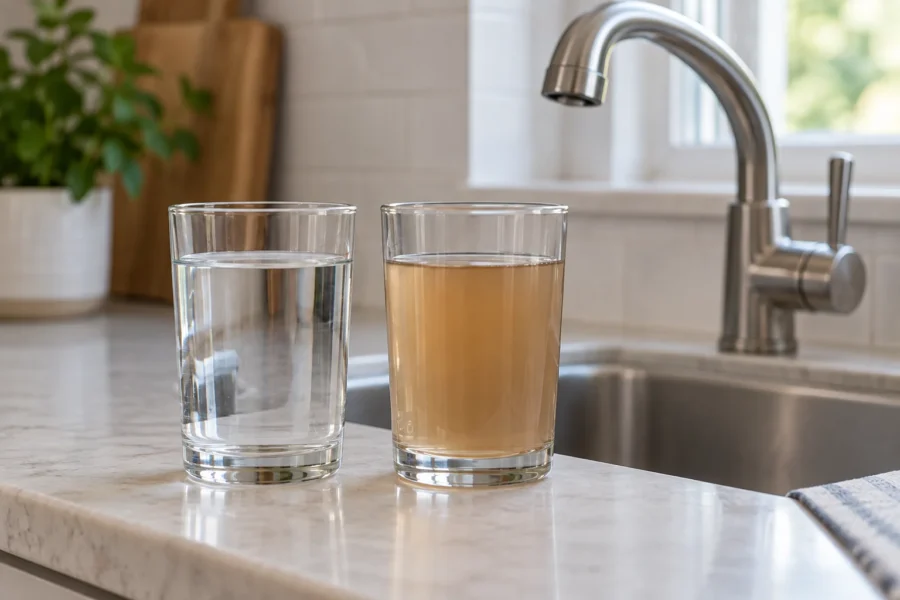
AI-generated illustration showing contrasting water appearances; it does not depict an inspected home or tested water sample.
If brown water comes from your faucet, check your water provider’s current notices and contact its water-quality team before choosing a fix. Use commercially bottled water for drinking and cooking while you get guidance about unexplained discoloration. Do not assume boiling, filtering, or running the tap will make it safe.
Brown, yellow, or rusty-looking water can originate in the public supply, building plumbing, or hot-water system. This guide helps households on a public water supply record the pattern and choose the next contact. For a private well, contact a qualified well professional or plumber and your local health department for appropriate well-water testing advice.
If the water looks white or milky rather than brown or rusty, use the cloudy-water guide to record how it clears and what remains. Keep following current local water-use instructions.
Check water-use notices before testing faucets
Use the provider named on your water bill, its official website, or its published phone number. Look for your service area, the notice time, and any update lifting or replacing an earlier advisory. In an apartment or condominium, also ask the building manager about plumbing work and instructions for shared equipment.
Report the discoloration even if you cannot find an outage notice. The Indiana Department of Environmental Management’s fact sheet advises utility customers to call their provider first. It also cautions that routine water-quality samples may not reflect conditions during the event you are experiencing.
If the change followed an interruption, keep the restoration message with your notes. Our no-water troubleshooting guide covers lost service and what to check when flow returns.
Read the exact type of advisory
The CDC distinguishes three drinking-water advisories:
- Boil water: use commercially bottled water or prepare tap water according to the advisory. Boiling addresses germs; it is not a general treatment for every cause of discoloration.
- Do not drink: use commercially bottled water for drinking, cooking, and other activities specified in the notice. Boiling water containing harmful chemicals or toxins will not make it safe.
- Do not use: avoid tap water for any purpose while the notice is in effect, including contact with it. Follow officials’ alternative-water instructions.
During an advisory, do not use refrigerator water or ice supplied by the affected water line. Check the notice for bathing, dishes, pets, and other household uses. A change back to clear water does not lift an advisory; wait for the official update.
Record where the color appears
Start with what you already observed. Only make further faucet comparisons if current instructions allow them. Do not taste the water to investigate, and avoid turning on multiple taps or running appliances simply to reproduce the problem.
| What you noticed | Useful detail to record | Next contact or question |
|---|---|---|
| Hot water is colored; cold appears clear | Which outlets, when it started, and recent heater or plumbing work | Ask the building manager or plumber to assess the hot-water system |
| Cold water, or both hot and cold, is colored at several outlets | Affected rooms, service interruption, and any pressure change | Ask the utility whether there is an area-wide event and what instructions apply |
| Only one outlet or part of the building is affected | Which outlets differ and whether the pattern repeats | Report the pattern to the manager or plumber; ask the utility if the source is uncertain |
| The color clears, then returns | Times, length of idle periods, and any utility-directed flushing already completed | Report the recurrence rather than repeatedly flushing without guidance |
Portland Water Bureau’s troubleshooting guide uses hot-versus-cold and one-versus-multiple-outlet comparisons. Hot-only discoloration can involve the heater or connected pipes; the pattern alone does not establish which part needs repair. If neighbors have already reported the same change, include that information without delaying your own report.
Why water can suddenly look brown
NYC DEP’s drinking-water FAQ describes building-pipe corrosion, rusting water heaters, and disturbances to water mains as possible sources. Changes in flow can stir up deposits that were previously settled in the piping.
That makes recent repairs, valve operations, or nearby hydrant activity useful context. It does not prove the cause at your address or establish whether the water is suitable for a particular use. Give the provider the observations and ask whether investigation or sampling is needed.
Follow your utility’s flushing instructions
Ask which cold-water outlet to use, how long to run it, when to stop, and what to do if the color remains. Also ask whether hot water and connected appliances should stay unused during the event.
There is no single flushing schedule for every public system. For example, Portland’s event guidance describes short hourly cold-water checks and says continuous running will not clear the water faster. Rochester Public Utilities’ guidance describes a longer initial cold-water flush. These are instructions for their respective customers, not competing recipes to try at your house.
During a sediment event, utilities may advise limiting hot-water use to avoid drawing discoloration into the heater and delaying light-colored laundry to prevent staining. Follow your provider’s directions for restarting appliances after the event. Do not drain the water heater or disconnect plumbing based only on color.
Prepare a useful report
Keep these details together so you can explain the problem without repeating unnecessary checks:
- Your service address or account reference, and the time you first noticed the change
- The observed hot/cold and outlet pattern, plus a photo if safely available
- Any loss of flow, pressure change, odor, or recent plumbing work
- The notice you followed, actions taken, and whether discoloration returned
Ask for a reference number and the next step if the problem persists. If the utility finds no supply issue, pass its response to the building manager or plumber. If the discoloration continues despite their guidance, ask the utility or your state drinking-water agency how to escalate the concern.
When the event is resolved
For a different symptom after the water-quality issue has been resolved, use the plumbing troubleshooting guide to choose a focused path for leaks, weak flow, or drain problems.
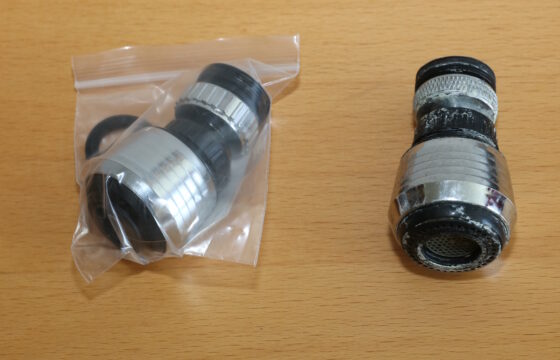
Follow the provider’s clearance and flushing directions before resuming normal water use. If an outlet remains weak afterward, sediment may need attention at the screen; use the faucet aerator guide only for an identifiable, accessible aerator and its approved cleaning method.
Keep the incident record with your home plumbing maintenance checklist. If odor is the remaining concern, the sink odor guide helps distinguish an observation about the water from a smell near the drain.